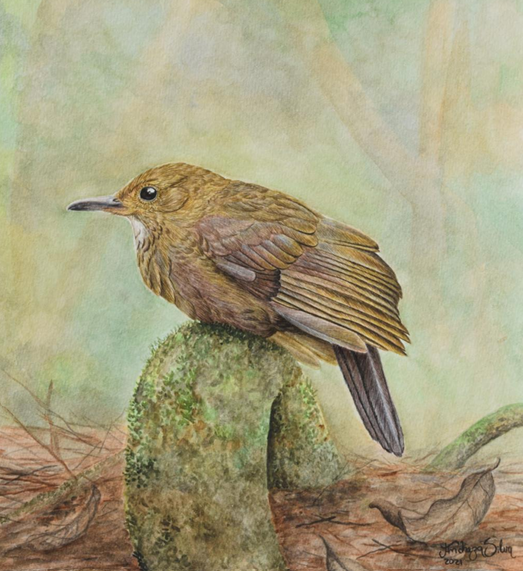
Illustration of Vira-folha-pardo (Sclerurus caudacutus calligineus). · Andreza Silva
Notes and context
Profile under editorial review. Some profile data, including taxonomic placement, may still be reviewed. Please consult the references listed on this profile.
Description
In the general species description, the brown leaftosser measures about 18.5 cm and has predominantly dark-brown plumage, with more rufous underparts and a dark tail; the throat is described as white, although the extent of this marking varies among subspecies. The general source does not provide a sufficient diagnosis to attribute all of these characters specifically to the taxon recorded on the sheet. [1][2]
Habitat
General sources describe the species in humid terra firme forests, on or near the ground, often close to fallen trunks. This description refers to S. caudacutus in the broad sense, not an ecological characterization exclusive to the form reported in the record; the national assessment restricts it to forest localities in Alagoas. [1][3]
Way of life
The species forages on the ground, turning over leaves to find insects and other small invertebrates. It is described as inconspicuous, occurring alone or in pairs and foraging on the forest floor; it may vocalize from low perches. These data come from sources on the species in the broad sense, and are not demonstrated specifically for the population attributed to calligineus. [1][2]
Distribution
The ICMBio assessment records S. c. caligineus only in Alagoas, in three documented localities: Jequiá da Praia, São Miguel dos Campos, and Murici; it also reports that the currently known occurrence is restricted to the Murici ESEC. [2][3]
Conservation
The global assessment by IUCN/BirdLife (2018) classifies Sclerurus caudacutus at the species level as Least Concern (LC); the national ICMBio assessment for S. c. caligineus was published in 2023 and assigned Critically Endangered (CR), with a category date of 14/06/2019. These are distinct taxonomic scopes (global species versus Brazilian subspecies), so the categories should not be treated as competing assessments of the same taxonomic unit. [3][4]