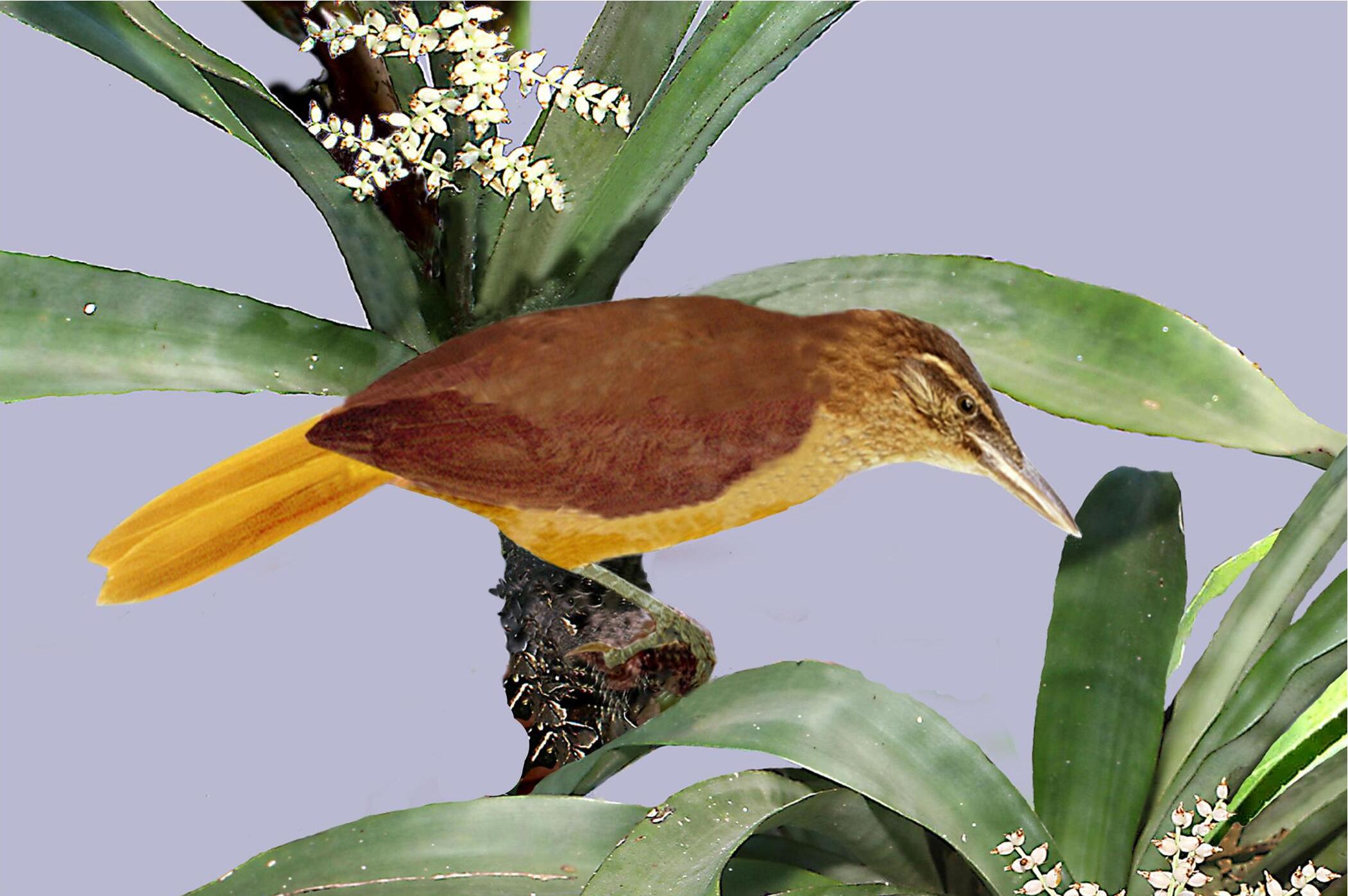
Photoart of the Cryptic Treehunter on a bromeliad by Rolf Grantsau, based on detailed photographs of the holotype (MN 34530), published in Revista Brasileira de Ornitologia, vol. 22, no. 2 (2014). Original file unchanged. CC BY 4.0 license: https://creativecommons.org/licenses/by/4.0/ · Rolf Grantsau
Notes and context
Profile under editorial review. Some profile data, including taxonomic placement, may still be reviewed. Please consult the references listed on this profile.
Description
Furnariid of about 20 cm, described in 2014 from a specimen collected in Murici, Alagoas. It is distinguished from Philydor novaesi, among other traits, by its larger, more robust build, dark crown and forehead, a stronger bill, and an orange tail contrasting with the back; the paper also compares its vocalizations with those of related species. [1][2]
Habitat
It was found in humid, dense, mountainous forest of the Pernambuco Center of Endemism, especially in the upper understory and the canopy, in areas of more open understory. The records and the description associate its foraging with arboreal bromeliads; these conditions refer to the known localities, not to a demonstrated occurrence in Bonito. [1][3]
Way of life
It foraged mainly in arboreal bromeliads, in the mid-stratum and in the subcanopy/canopy. The original source describes specialization on this substrate, and the BirdLife summary records the species in these forest strata; there is no basis here to add prey, reproduction, or other undocumented habits. [1][3]
Distribution
Endemic to the Pernambuco Center of Endemism, in northeastern Brazil, north of the São Francisco River. The consulted literature recognizes only Murici (Alagoas) and the Pedra d’Anta reserve, near Frei Caneca/Jaqueira (Pernambuco); the most recent known records were from Murici in 2007 and from Frei Caneca in 2005. [1][3][4]
Conservation
The IUCN global assessment, presented by BirdLife, changed from Critically Endangered (2016) to Extinct (2019), based on the absence of records after 2007 and on searches carried out. As a historical national reference, Portaria MMA nº 444/2014 included the species as EX (BR), i.e., extinct in Brazil. These are different scopes and years; confirm the current national list before updating any conservation text. [3][5]
References
[1]
Barnett, J. M. & Buzzetti, D. R. C. (2014). “A new species of Cichlocolaptes Reichenbach 1853 (Furnariidae), the ‘gritador-do-nordeste’, an undescribed trace of the fading bird life of northeastern Brazil.” Revista Brasileira de Ornitologia — 22(2): 75–94