Profile under editorial review. Some profile data, including taxonomic placement, may still be reviewed. Please consult the references listed on this profile.
Description
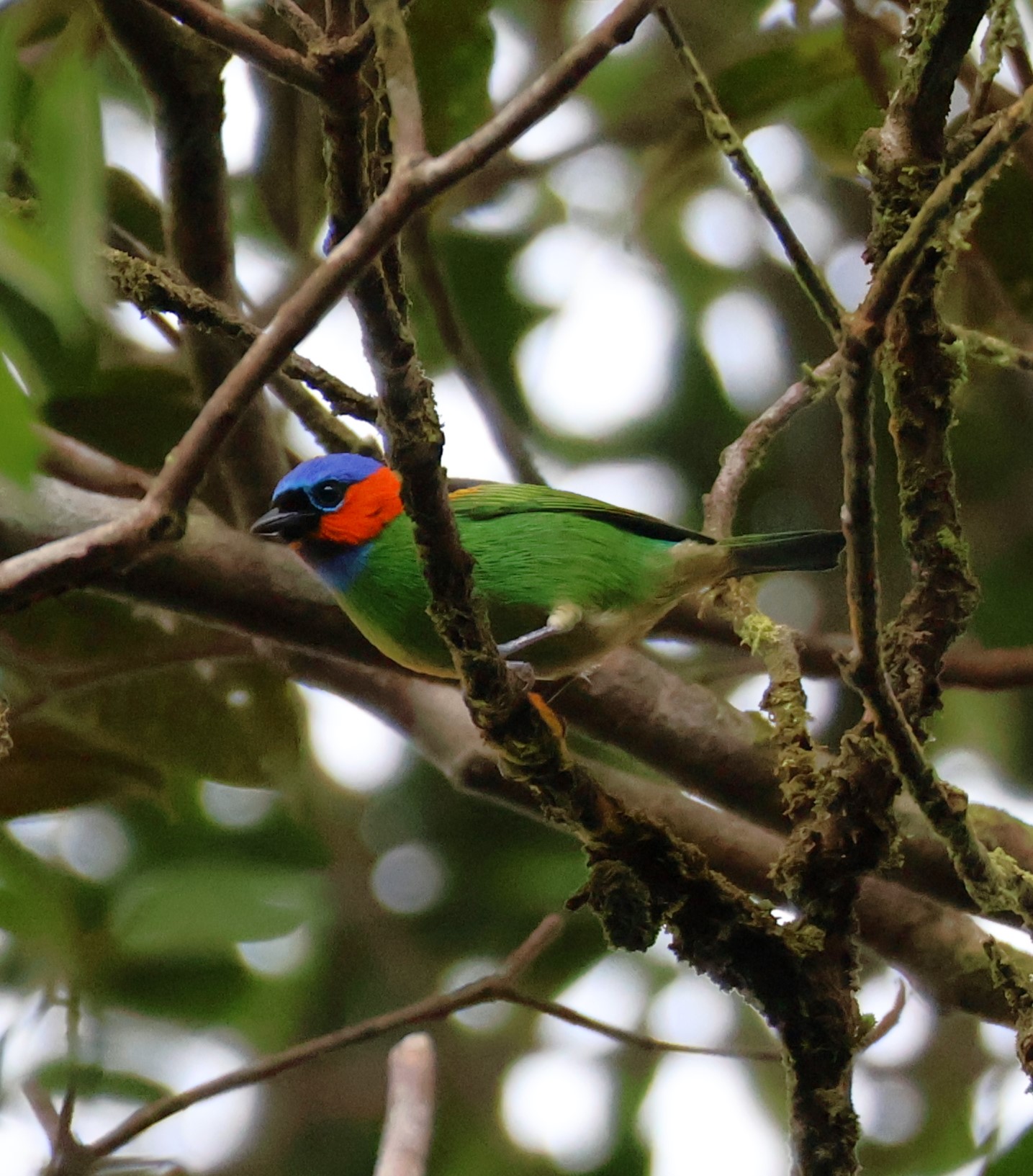
The saíra-militar is a small thraupid with green plumage, a dark blue crown, red throat and nape, and yellow‑orange areas on the wings. The red band is more extensive in the adult birds described for the species; females may show less intense red. The combination of colors is characteristic, but the intensity and extent of the markings vary among populations. The sources consulted describe the species at the specific level and do not allow confidently attributing all of these characters exclusively to the subspecies corallina. [1][2]
Habitat
The species is associated with humid forests, using the canopy as well as forest edges and wooded areas. The eBird page for Bonito includes the species on the regional illustrated checklist, but this does not allow determining the habitat of each local record. The report of use of edges and small forest patches in the Brazilian source consulted is general for the species, not a description of microhabitat in Bonito. [1][2][3]
Way of life
It feeds on fruits and insects, according to the sources consulted. It is observed in small groups and may join mixed flocks in the mid‑story and the understory; it also visits sites with available fruits. These pieces of information refer to the species Tangara cyanocephala in general. The open sources consulted do not support specific diet or behavior details exclusive to T. c. corallina, nor do they permit adding migration or reproduction data to this account. [1][2]
Distribution
The species occurs in eastern South America, primarily in Brazil, with extensions into eastern Paraguay and northeastern Argentina. There are disjunct populations in northeastern Brazil, including areas of Pernambuco and Alagoas; the Brazilian source consulted places corallina from the Pernambuco coast to Espírito Santo, but records uncertainty about the limits of this taxon. The eBird illustrated checklist for Bonito, Pernambuco, includes the species; the source consulted does not identify the subspecies nor allow assigning a more precise location within the municipality. [1][2][3]
Conservation
The global assessment by BirdLife/IUCN for Tangara cyanocephala is Least Concern (LC); the page consulted shows an assessment from 2024 and also an LC history in 2016. Separately, the official Brazilian national list of 2026 includes Tangara cyanocephala cearensis as Vulnerable (VU), not T. c. corallina. These categories have different taxonomic/geographic scopes and should not be treated as equivalent or used to replace any registered text. The account retains the scientific name and the provisional status received; a review of the taxonomic applicability of these assessments to the indicated form is recommended. [4][5]
References
[1]
Birds of the World / Cornell Lab of Ornithology. “Red-necked Tanager — Tangara cyanocephala”, visão geral e distribuição (página consultada; revisão indicada em 2024)
Ministério do Meio Ambiente e Mudança do Clima. Portaria MMA nº 1.704, de 16 de junho de 2026, Anexo I (lista nacional; Tangara cyanocephala cearensis, VU)