Profile under editorial review. Some profile data, including taxonomic placement, may still be reviewed. Please consult the references listed on this profile.
Description
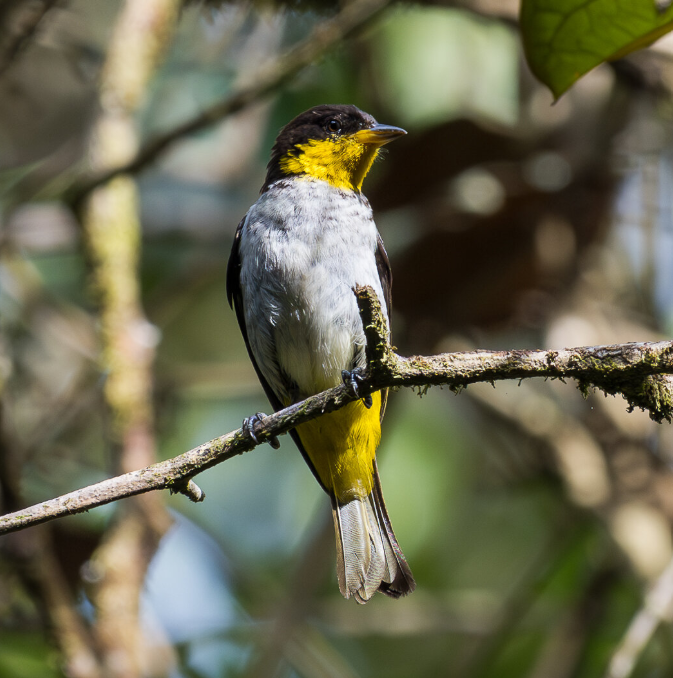
Small tanager of about 14 cm. The male has a predominantly black back, a yellow area on the lower back and uropygium, a yellow throat and pale underparts; the female is olive‑green above and yellow below. These sexual differences help with identification, but the descriptions consulted treat the species H. flavicollis in the broad sense, not exclusively the registered subspecies. [1][2]
Habitat
It is associated with humid forests, including terra firme and várzea forests, using mainly the canopy and forest edges; it may occur in adjacent clearings. The general species description also places it in the canopy of relatively tall forests. The regional article includes the form melanoxantha in forest environments of the Pernambuco Endemism Center, without discriminating all records by municipality. [1][2][5]
Way of life
Actively forages among leaves, including in the canopy and on emergent trees; the described diet includes insects and small fruits. It is frequently observed in pairs and also accompanies mixed-species flocks. The sources consulted do not support specific statements about migration or reproduction for the registered subspecies, so these aspects are not attributed to it here. [1][2]
Distribution
In the recorded taxonomy, H. f. melanoxantha is associated with eastern Brazil, with distribution references for Pernambuco and Bahia; the nominal species H. flavicollis has a wider distribution, including the Amazon and areas of the Atlantic Forest. the regional survey includes localities of Bonito and the form in the regional list, but does not individually link the species to those points. [3][4][5]
Conservation
Global: Birds of the World displays LC for H. flavicollis in the broad sense; the page states a textual update in 2011 and does not present, in the accessible content, a separate assessment for melanoxantha. [1] National/regional: the study published in 2024 presents H. f. melanoxantha as DD in the analytical set for the Pernambuco Endemism Center; this is the category attributed in the study/modeling, not a confirmation of an official national legal category. It was not possible to verify an official national assessment specific to the subspecies in the sources consulted. [6]
References
[1]
Birds of the World / Cornell Lab of Ornithology. “Yellow-backed Tanager (Hemithraupis flavicollis)”, introdução e visão geral (texto atualizado em 2011)
Pereira et al. (2016). “Distribution and conservation of three important bird groups of the Atlantic Forest in north-east Brazil”. Brazilian Journal of Biology
da Costa Dias et al. (2024). “Endemic and threatened birds as surrogates for identifying conservation priority areas and ecological corridors in the America's most endangered habitat”. Scientific Reports