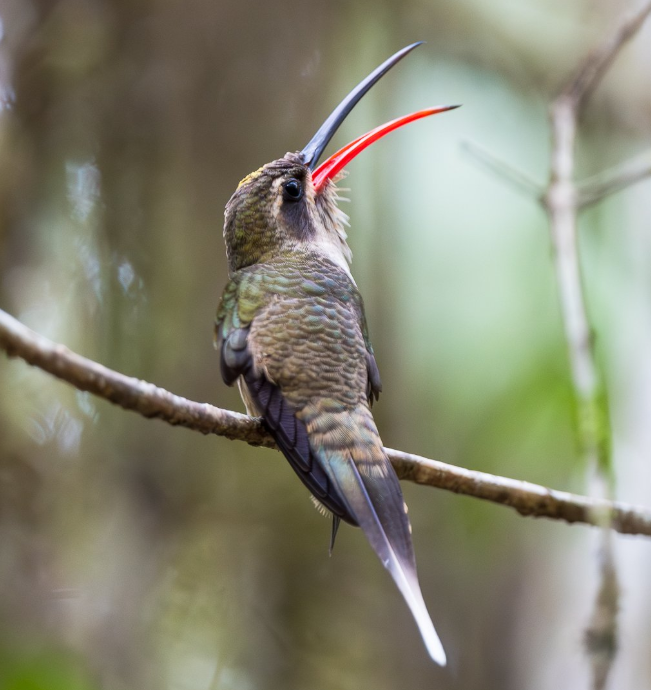
Profile under editorial review. Some profile data, including taxonomic placement, may still be reviewed. Please consult the references listed on this profile.
Description
Hummingbird of the family Trochilidae. The identity of camargoi appears in divergent taxonomic concepts: the Brazilian assessment of 2018 treated it as a valid subspecies of Phaethornis margarettae, while the current Avibase concept groups it under P. malaris [1][2]. For camargoi, the Brazilian assessment mentions vocal and morphological differences relative to the nominate form, but records that there is little natural history information; the sources consulted do not provide a complete descriptive diagnosis specific to this taxon [2].
Habitat
The specific Brazilian assessment reports use of the low to mid understory in forests, occurring more frequently near bodies of water or flooded areas. The preferred habitat is fragmented into small, isolated remnants; the source records occurrence between 5 and 700 m of altitude [2].
Way of life
Little is known about the natural history of the taxon. The Brazilian assessment reports foraging in bromeliads and plants of the genus Heliconia, as well as use of the low to mid understory [2]. The specific sources consulted do not support statements about migration, breeding season, mating system, or diet beyond these foraging resources.
Distribution
Taxon endemic to Brazil, restricted to the Pernambuco Endemism Center, in the states of Pernambuco and Alagoas, according to the national assessment [2]. There is a published record in Mata do Cedro, municipality of Rio Largo/AL, in a survey carried out from 2010 to 2011 [3].
Conservation
ICMBio's 2018 national assessment classified P. m. camargoi as Critically Endangered (CR), criterion C2a(i), and reported that there was no global assessment for the taxon [2]. The national list in Portaria MMA nº 444/2014 also lists Phaethornis margarettae camargoi separately as CR [7]. In contrast, the BirdLife/IUCN 2018 assessment classifies Phaethornis malaris as LC (Least Concern), but under a broad concept that includes multiple populations/subspecies; this is not equivalent to a global assessment specific to camargoi [1][6]. Portaria MMA nº 1.704/2026 lists Phaethornis margarettae as EN, without a separate line for camargoi; because the taxonomic scope of that entry does not directly clarify the treatment of the subspecies in this account, the relationship between the 2018 category and the current listing requires review before any conclusion [8].
Campos, L.F.A.S., Teixeira, B.P. & Efe, M.A. (2018). “The importance of isolated patches for maintaining local bird biodiversity and ecosystem function: a case study from the Pernambuco Center of Endemism, Northeast Brazil.” Iheringia — Série Zoologia
Pereira, G.A. et al. (2016). “Distribution and conservation of three important bird groups of the Atlantic Forest in north-east Brazil.” Brazilian Journal of Biology