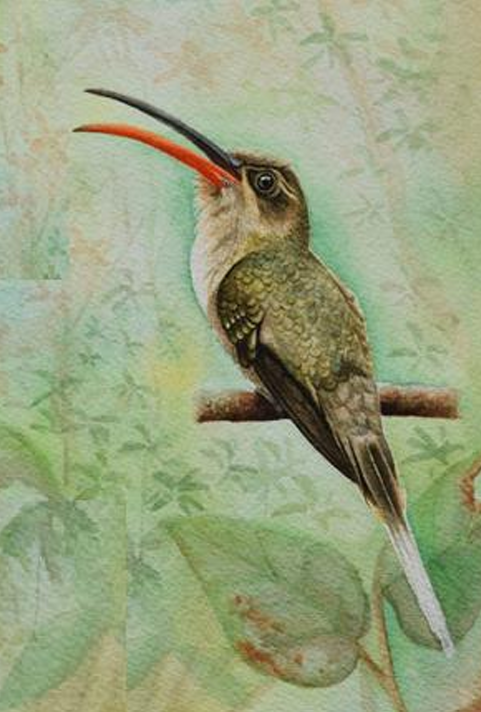
Illustration of Rabo-branco-de-margaretta (Phaethornis margarettae) · Andreza Silva
Notes and context
Profile under editorial review. Some profile data, including taxonomic placement, may still be reviewed. Please consult the references listed on this profile.
Description
Relatively large hummingbird, with elongated central rectrices with white tips, conspicuous facial markings, grayish underparts, and pale ochre-colored stripes on the head. The source consulted reports a reddish or orange bill and little apparent sexual dimorphism. These characteristics are presented under the name Phaethornis margarettae on WikiAves; since global lists treat that name as a subspecies of P. malaris, the description should be understood with that taxonomic caveat. [2][7]
Habitat
A historical source from the U.S. Fish and Wildlife Service describes the form margarettae in the understory of coastal tropical forest, primary or secondary. This description was published under a different taxonomic treatment.
Way of life
The same historical source describes feeding on nectar and small arthropods and mentions possible local movements related to flowering. Information is retained with the caveat of the taxonomic treatment; it does not confirm behavior in the municipality of Bonito, Pernambuco, Brazil.
Distribution
Under the concepts of the consulted global lists, margarettae is associated with the coastal stretch of eastern Brazil, from Pernambuco to Espírito Santo. CBRO recognizes it as a separate species.
Conservation
EN — Endangered on the Official Brazilian National List (Ordinance MMA No. 1.704/2026, which lists Phaethornis margarettae). No independent global assessment was verified for this separate concept; the LC category assigned by BirdLife to Phaethornis malaris refers to the broader taxonomic concept and is not automatically transferred to this record.
References
[1]
Portaria MMA nº 1.704, de 16 de junho de 2026 — Anexo I, Phaethornis margarettae, EN — Ministério do Meio Ambiente e Mudança do Clima / Diário Oficial da União