Profile under editorial review. Some profile data, including taxonomic placement, may still be reviewed. Please consult the references listed on this profile.
Description
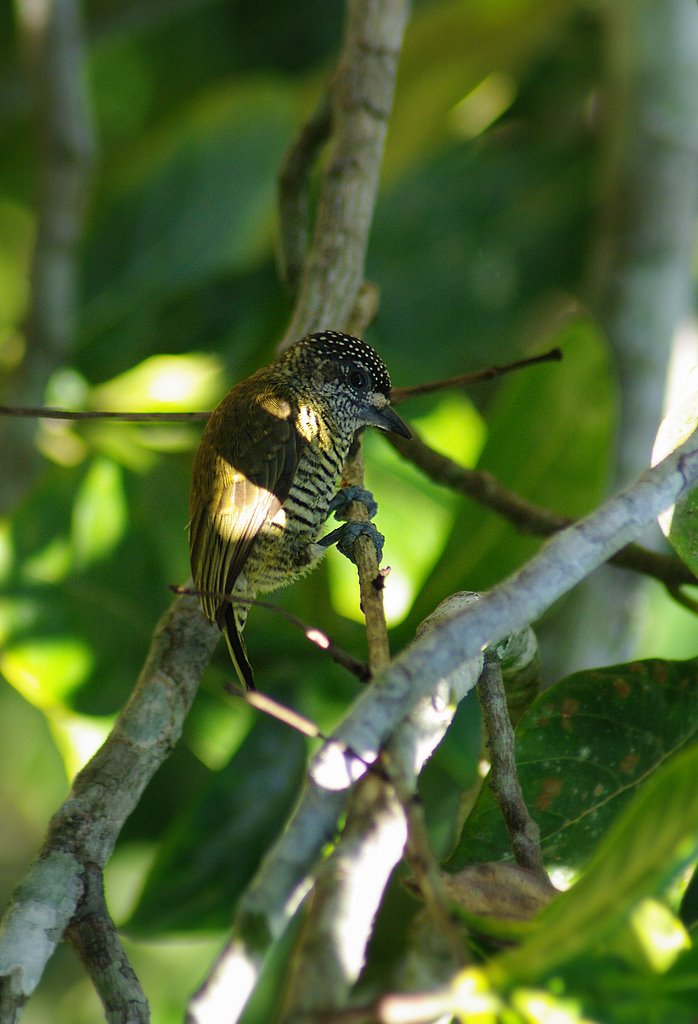
Small woodpecker, about 10 cm. The plumage described for the species includes a greenish back and a yellowish belly with black bars or spots; there is a white post-ocular stripe, and the spotting pattern on the back can vary. The combination and coloration must be interpreted with caution, because the taxonomic literature separates populations previously grouped in the Picumnus exilis complex.[1][2]
Habitat
Natural history sources place these piculets at edges of humid forests, old secondary growth and disturbed forests, as well as savannas; forest openings and dense riparian areas with bamboo are also cited.[1] For the northeastern population treated by Rêgo et al. as Picumnus pernambucensis, there are records in coastal forests, estuarine environments and mangroves, in lowland and also montane areas.[2]
Way of life
It is described as active but inconspicuous, foraging at different heights, in pairs or family groups of three to five individuals.[1] It searches for ants and other insects, sometimes following mixed-species flocks; it is also observed hopping in dense vegetation and clinging to branches, pecking them while searching for food.[1] WikiAves also reports ants as documented food and solitary or paired foraging.[3]
Distribution
The global BirdLife assessment records the species in Brazil, Colombia, French Guiana, Guyana, Suriname and Venezuela.[4] However, a revision based on 487 specimens recognized P. exilis (Bahia and Sergipe, south of the São Francisco) and split off P. pernambucensis, from the Atlantic belt north of the river, including Alagoas, Pernambuco and Paraíba.[2] The eBird checklist for the Bonito region includes P. exilis; the consulted entry did not disclose the locality or the details of the individual record.[5]
Conservation
The global BirdLife/IUCN assessment classifies Picumnus exilis as Least Concern (LC), with a 2024 assessment.[4] The Brazilian national category is a separate assessment; it was not possible to confirm in the open sources consulted an official national category specific to the taxon under the name received. Check the current official Brazilian list separately before any update.
References
[1]
Winkler, H. & Christie, D. A. (2016, atualização da página). “Golden-spangled Piculet, Picumnus exilis”. Birds of the World, Cornell Lab of Ornithology
Rêgo, M. A., Del-Rio, G. & Silveira, L. F. (2014). “A taxonomic review of Picumnus exilis (Aves: Picidae) reveals an underestimation of Piculet species diversity in South America”. Journal of Ornithology 155: 853–867