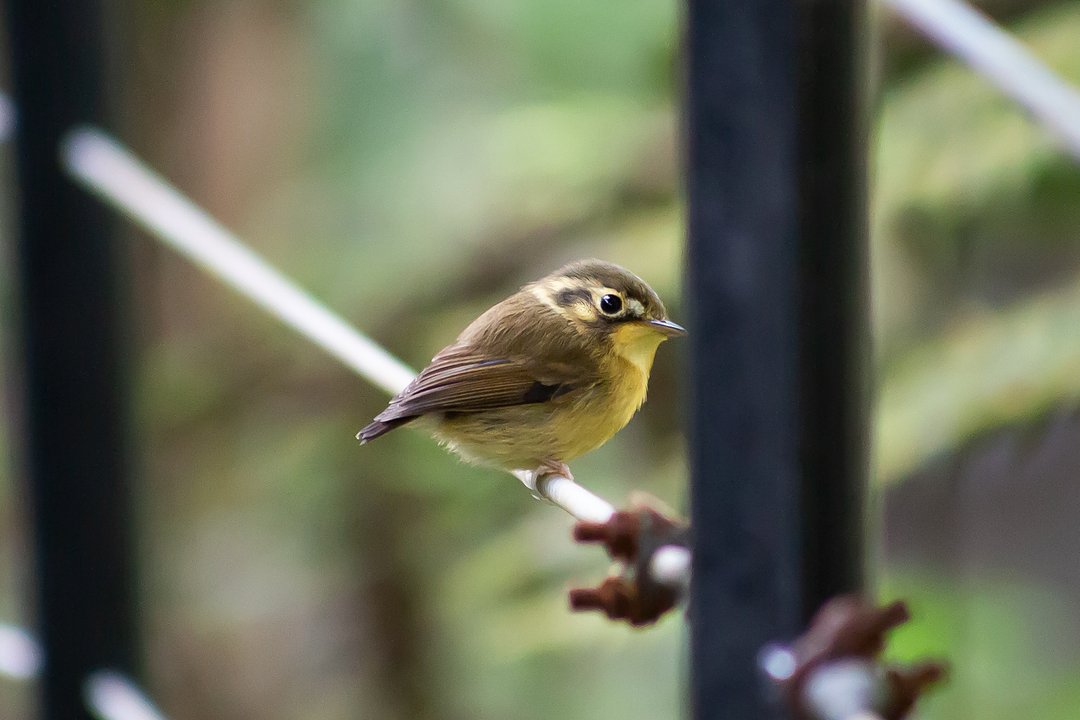
Profile under editorial review. Some profile data, including taxonomic placement, may still be reviewed. Please consult the references listed on this profile.
Description
The patinho is a very small tyrannid, about 10 cm; the typical form of the genus has a relatively large head and short tail, characteristics useful for recognizing the bird's silhouette. The sources consulted describe the species in the broad sense, P. mystaceus, not an independent diagnostic description of niveigularis; therefore, these characters are presented with that caveat and not as a taxonomic diagnosis of the registered subspecies. [1][2]
Habitat
The species is associated with the understorey of humid lowland and montane forests, as well as tall secondary growth and gallery forests; it may occur in dense vegetation, including edges with tangled growth. These descriptions are for P. mystaceus in the broad sense and do not demonstrate a microhabitat preference exclusive to niveigularis nor presence at a specific site in Bonito. [1][2]
Way of life
The species forages for insects: it may remain motionless on a perch in dense vegetation, watch the surroundings, and make short sallies to capture prey in the foliage, returning to the perch. It is described as solitary and generally not a participant in mixed-species flocks. The sources consulted do not show that these behaviors have been studied separately for the northeastern population attributed to niveigularis. [2]
Distribution
The form called niveigularis is indicated for the coastal forests of the Northeast, from Paraíba to Alagoas. A genomic and vocal study published in 2026 recognized this northeastern group as a distinct evolutionary lineage and proposed treating it as P. niveigularis; this is recorded here only as a divergence among sources, without changing the registered scientific identification. the regional distribution does not demonstrate local occurrence. [3][4]
Conservation
The 2021 BirdLife/IUCN global assessment classifies Platyrinchus mystaceus (Eastern White-throated Spadebill, in the taxonomic concept of the assessment) as Least Concern (LC). Separately, the updated official Brazilian national list under Portaria MMA nº 1.704/2026 includes Platyrinchus niveigularis as Vulnerable (VU). The categories refer to different scopes and taxonomic concepts: the global LC does not equate to the national assessment, and the global assessment consulted predates the 2026 proposal to separate niveigularis as a species. Confirm the correspondence of these concepts with the administrative taxon before any revision of the conservation status field. [5][6][4]
References
[1]
Birds of the World / Cornell Lab of Ornithology. “White-throated Spadebill (Platyrinchus mystaceus)”. Conta consultada (texto atualizado em 29 mar. 2017)
Bocalini, F.; Bolívar-Leguizamón, S. D.; Vaz, R. V.; Silveira, L. F. 2026. “Integrating genomic and vocal evidence to reassess species’ limits and the biogeography of a widely distributed Neotropical passerine, the white-throated spadebill, — Platyrinchus mystaceus”. Zoological Journal of the Linnean Society 206(1), zlaf197
Pereira et al. 2016. “Distribution and conservation of three important bird groups of the Atlantic Forest in north-east Brazil”. Brazilian Journal of Biology