Profile under editorial review. Some profile data, including taxonomic placement, may still be reviewed. Please consult the references listed on this profile.
Description
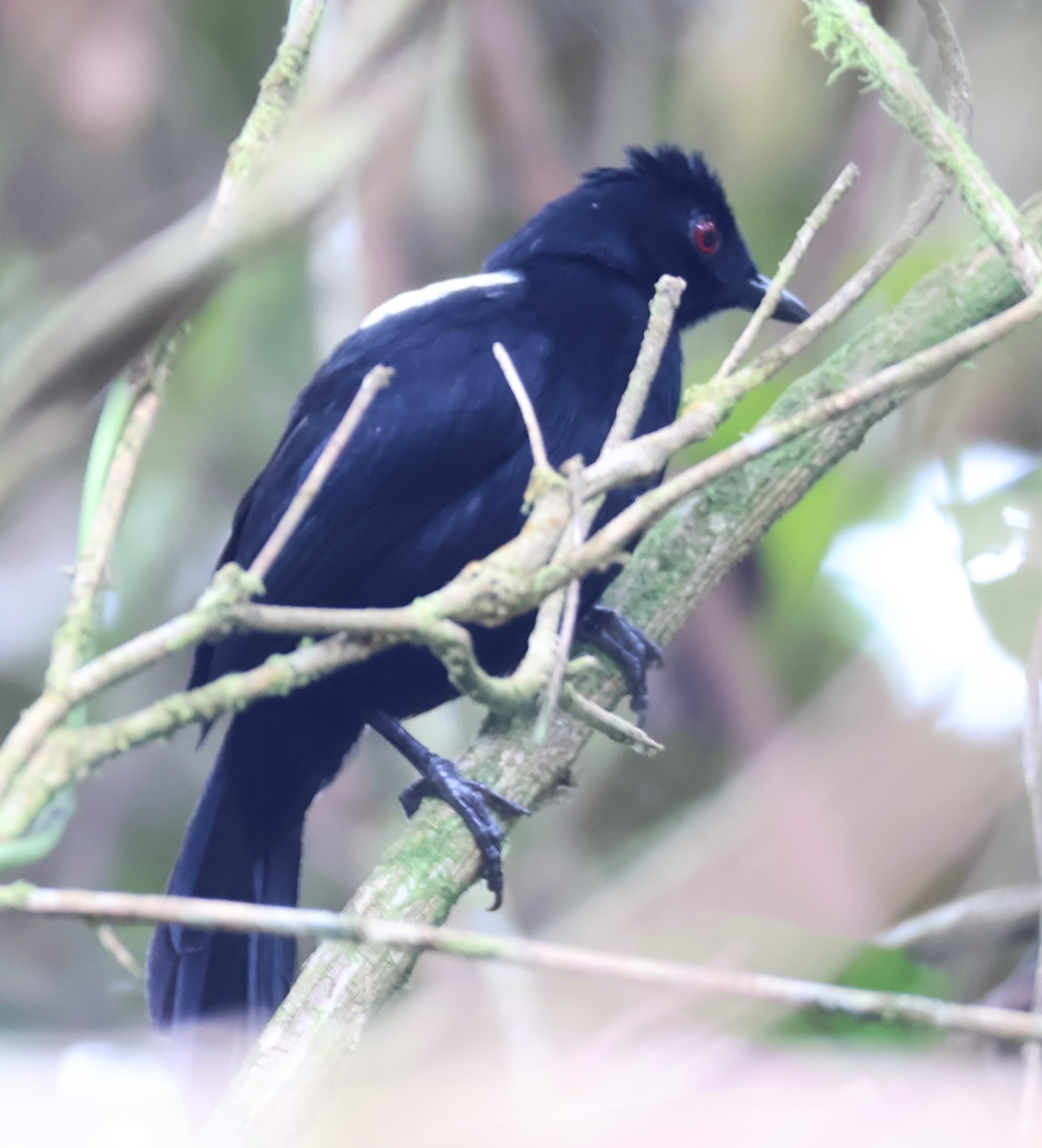
In adult plumage, the male is predominantly black, with red eyes and a small white patch on the nape; the female is brown, also with a white nuchal mark. Juveniles are also illustrated in the sources consulted. A study of vocalizations and plumage found diagnostic differences, but notes that pernambucensis still falls within Pyriglena leuconota under the taxonomic treatment proposed by the authors. [1][2]
Habitat
It is associated with the Atlantic Forest of the Pernambuco Center of Endemism, in understory forests. In Mata do Cedro, Rio Largo (AL), a field study in open ombrophilous forest found greater occurrence in plots with denser vegetation at 0.5–1.5 m; this evidence is specific to that site, not a description of Bonito. WikiAves also describes a preference for dense, shaded understory. [1][3]
Way of life
It is insectivorous and takes insects in low vegetation and on the ground. The sources describe movement by short hops at low heights in the forest; the ecological study also characterizes it as an insectivorous bird that forages on the ground and in the understory foliage. No statements about migration or reproduction are added, not supported here by sufficient specific information. [1][3]
Distribution
It is endemic to the Brazilian Northeast, associated with the Pernambuco Center of Endemism. Avibase, under the concept of the subspecies P. leuconota pernambucensis, places the form in eastern Pernambuco and eastern Alagoas; WikiAves also mentions Paraíba and reports in Sergipe and Rio Grande do Norte. There is direct municipal-level evidence in Bonito/PE: the WikiAves list records an audio of the species published on 14/01/2014. That record does not prove current presence. [1][4]
Conservation
The global BirdLife/IUCN assessment of 2024 classifies Pyriglena leuconota as LC and follows the broad concept that includes pernambucensis as a subspecies; the Brazilian Official National List published by Portaria MMA nº 1.704/2026 lists Pyriglena pernambucensis as VU. The categories are from distinct assessments and should not be confused or treated as a municipal assessment. Isler & Maldonado-Coelho (2017) recommended retaining pernambucensis within P. leuconota in the treatment adopted, although they noted that its vocal and plumage differences approach the criteria that could support specific recognition under the phylogenetic concept. [2][5][6]
Population density estimates and key microhabitat parameters for two endangered tropical forest understory insectivorous passerines from the Pernambuco Endemism Center — Prado et al., 2022