Profile under editorial review. Some profile data, including taxonomic placement, may still be reviewed. Please consult the references listed on this profile.
Description
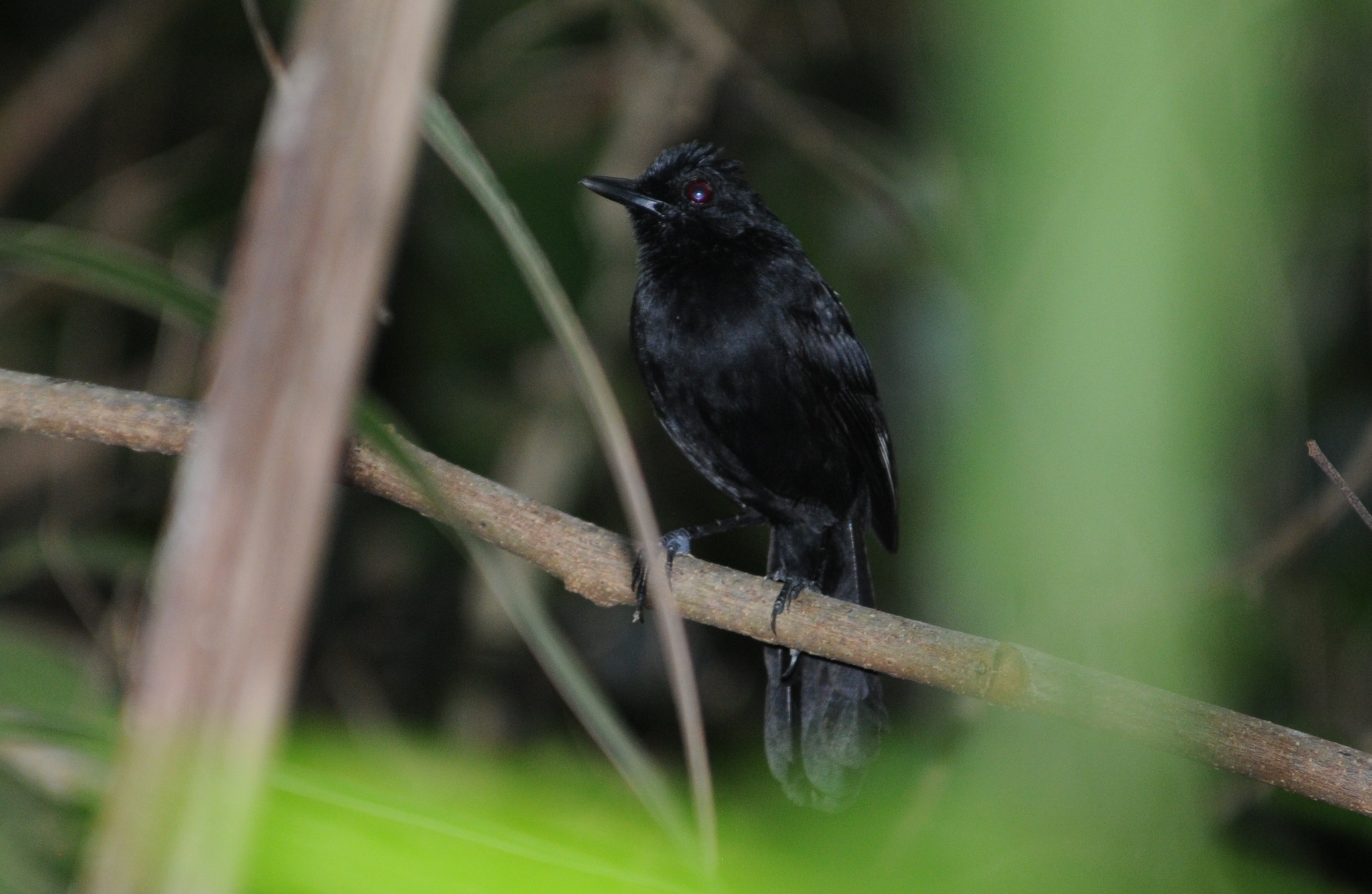
The Bahia antshrike is a passerine in the family Thamnophilidae, with marked sexual dimorphism: the male is black and has a white interscapular patch, while the female is brown and does not show this patch. In adults, the iris is red. Identification should take into account that other species of the genus Pyriglena are similar; differences in plumage and vocalization help to distinguish them. [2][3][4]
Habitat
It inhabits tangled understory of lowland forests, including tall capoeiras and other secondary or semi-open patches with horizontal perches close to the ground. It occurs at about 20 to 250 m in elevation; the species still depends on forest understory, even though it can persist in secondary vegetation. [1]
Way of life
It is observed in pairs and small groups, occasionally up to 26 individuals. It regularly follows army-ant swarms, capturing displaced arthropods, and rarely joins mixed-species flocks. The consulted assessment does not consider it migratory; [1][3]
Distribution
The known distribution of P. atra is restricted to the coastal Atlantic Forest belt of Bahia, from the surroundings of Salvador and Saubara northward to Sergipe, with records also in coastal Bahian fragments. the WikiAves page of first sound records for Bonito lists Pyriglena pernambucensis, not P. atra. That record of another taxon does not prove the presence of the species in this account. [1][5]
Conservation
The consulted official national list (Portaria MMA nº 148/2022, Anexo I) classifies Pyriglena atra as Endangered (EN); the global IUCN/BirdLife assessment displayed on the species sheet is Near Threatened (NT), the 2025 assessment. The global category does not replace the national one, and neither of the two constitutes the municipal assessment for Bonito. [1][6]
References
[1]
BirdLife International / IUCN. Fringe-backed Fire-eye — Pyriglena atra, ficha e avaliação global (2025)
Isler, M. L. & Maldonado-Coelho, M. (2017). “Calls distinguish species of Antbirds (Aves: Passeriformes: Thamnophilidae) in the genus Pyriglena”. Zootaxa 4291(2).