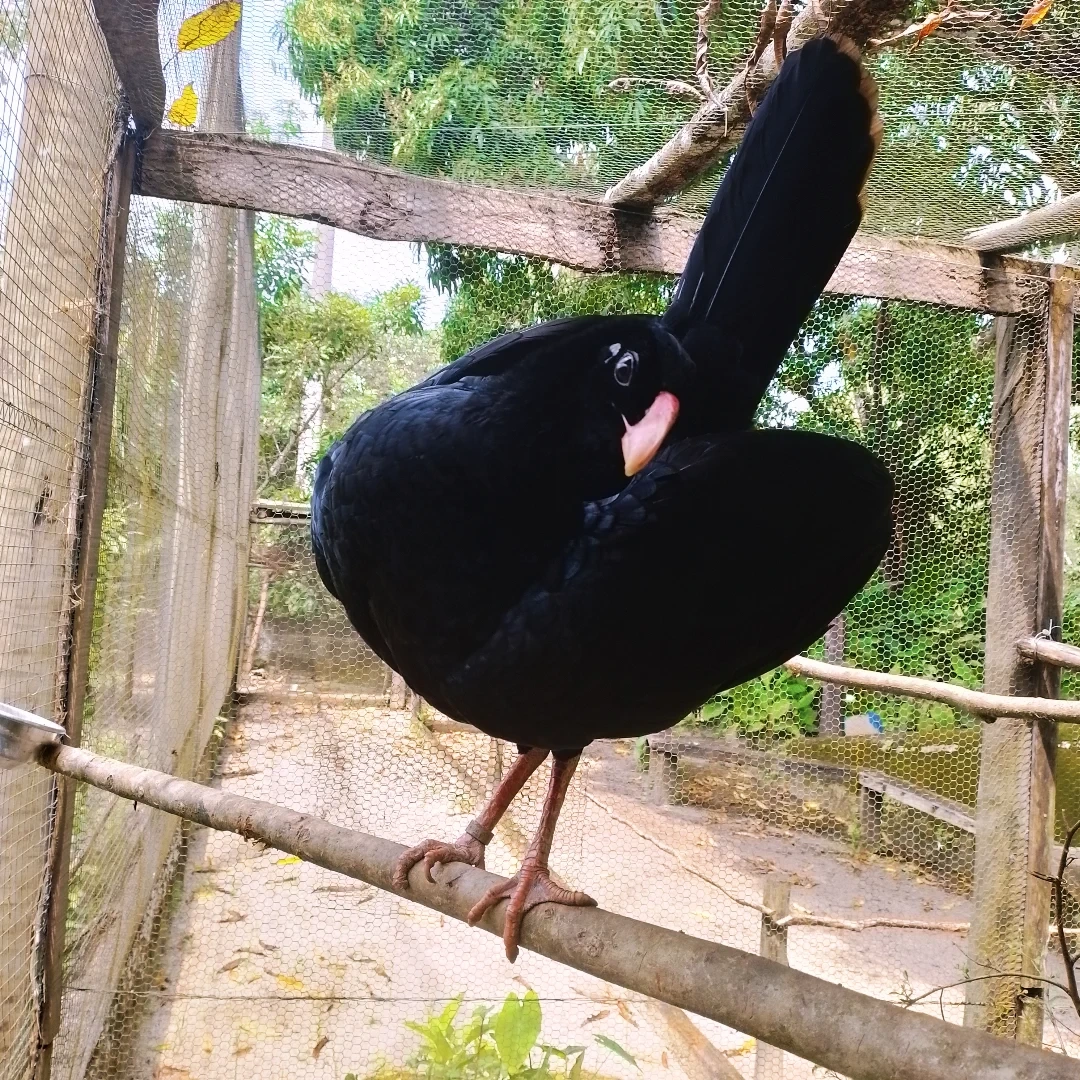
Profile under editorial review. Some profile data, including taxonomic placement, may still be reviewed. Please consult the references listed on this profile.
Description
The revised taxonomic literature recognizes the mutum-de-alagoas as a full species. The Brazilian list uses the combination Pauxi mitu, while some global sources employ Mitu mitu. Among the diagnostic characters described are the bicolored bill, the bare auricular region and the pattern of the tail feathers. The species is classified as Extinct in the Wild; this does not mean global extinction, as there are birds maintained in captivity.
Habitat
Historically associated with lowland coastal forests of Brazil's Northeast. The literature records uncertainty about the extent of the historical distribution and does not document habitat currently occupied in the wild.
Way of life
The available reports are scarce and historical. Individuals have been observed feeding on fruits of trees in the family Myrtaceae, and the Brazilian description reports consumption of fruits fallen to the ground; this supports the use of plant food but does not provide a complete characterization of the diet. Insufficient data were found to detail routine, migration, or social behavior. [2][5]
Distribution
Endemic to northeastern Brazil. The review by Silveira, Olmos and Long (2004) reports that the confirmed observation records and specimens known at that time were from Alagoas; the broader historical distribution attributed to the coastal forests of Pernambuco and Alagoas is treated with uncertainty.
Conservation
EW — Extinct in the Wild on the Brazilian Official National List (Portaria MMA nº 1.704/2026, Annex I) and in the global assessment cited by BirdLife. EW does not mean global extinction; there are individuals in captivity.
References
[1]
Portaria MMA nº 1.704, de 16 de junho de 2026 — Anexo I, Pauxi mitu, EW — Ministério do Meio Ambiente e Mudança do Clima / Diário Oficial da União