Profile under editorial review. Some profile data, including taxonomic placement, may still be reviewed. Please consult the references listed on this profile.
Description
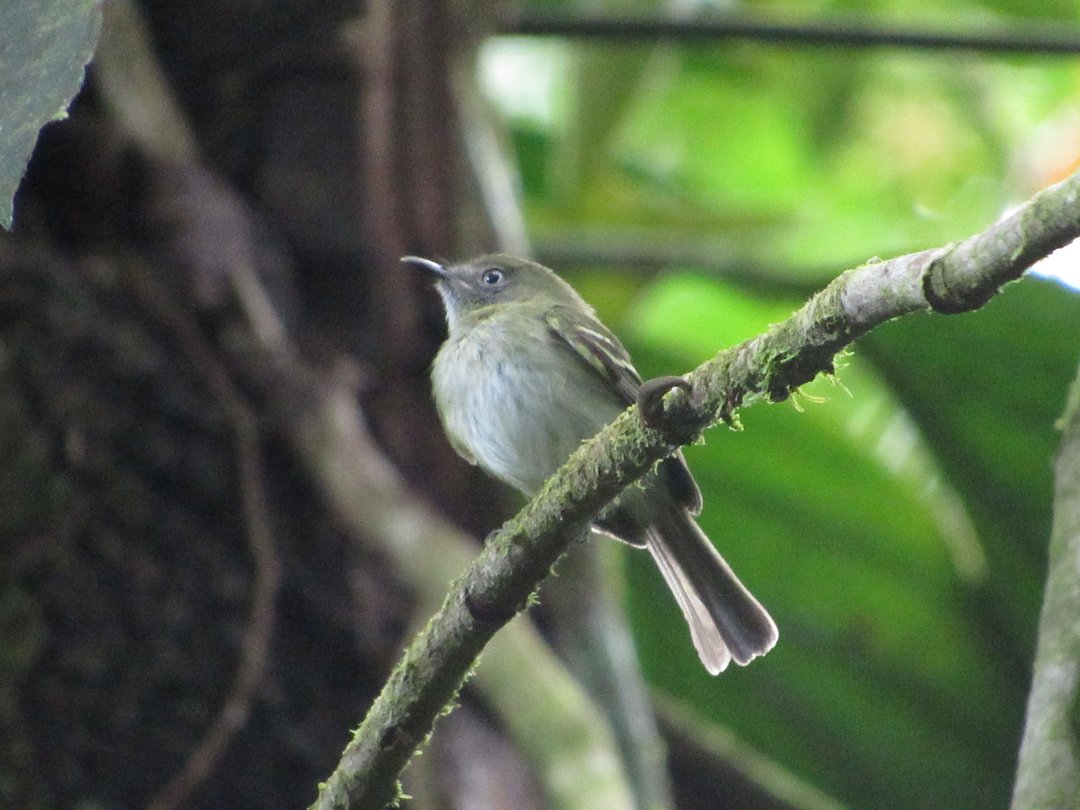
Small maria, about 11 cm; the published description for Hemitriccus griseipectus reports olive plumage on the upperparts, a pale throat and underparts, a grayish breast, and a pale iris. The source also describes pale bars on the wings and yellowish flanks. These characters are presented for the species under the binomial name, not as a comparative diagnosis exclusive to naumburgae; they should not be treated as independent confirmation of the subspecies. [1][2]
Habitat
The subspecies is treated in the literature as associated with the forests of the Centro de Endemismo Pernambuco, in the northeastern Atlantic Forest. A study describes it as using the understory and midstory of forested areas, where it captures insects; this supports the use of forest, but does not permit assigning habitat to any specific municipal record. [2]
Way of life
It is a small insectivorous tyrant flycatcher: in forest it forages in the understory and midstory and captures insects. The general species description likewise reports searching for food in those strata and making short sallies to reach foliage. The sources consulted do not support specific statements about migration or reproduction of the subspecies. [1][2]
Distribution
H. g. naumburgae is treated in a scientific article as an endemic taxon of the Centro de Endemismo Pernambuco, in the Atlantic northeastern region; the WikiAves account attributes the form to the Brazilian Northeast, from Rio Grande do Norte to Alagoas. [1][2]
Conservation
The consulted global BirdLife/IUCN assessment assigns Least Concern (LC), 2024, to the taxon treated as Hemitriccus griseipectus at species level; this is not equivalent to an independent assessment of the subspecies. In contrast, the study by Prado et al. (2022), citing ICMBio (2018), reports Vulnerable (VU) in the national assessment for H. g. naumburgae. These are assessments from different jurisdictions and taxonomic scopes; do not harmonize or transfer categories in this record without reviewing the original bases. [2][3][6]
Prado, L. C. (2022) — “Population density estimates for three endangered bird taxa from the Pernambuco Endemism Center, northeastern Brazil”, Biota Neotropica 22(3).
Pereira et al. (2016) — “Distribution and conservation of three important bird groups in the Pernambuco Endemism Center”, Brazilian Journal of Biology.