Profile under editorial review. Some profile data, including taxonomic placement, may still be reviewed. Please consult the references listed on this profile.
Description
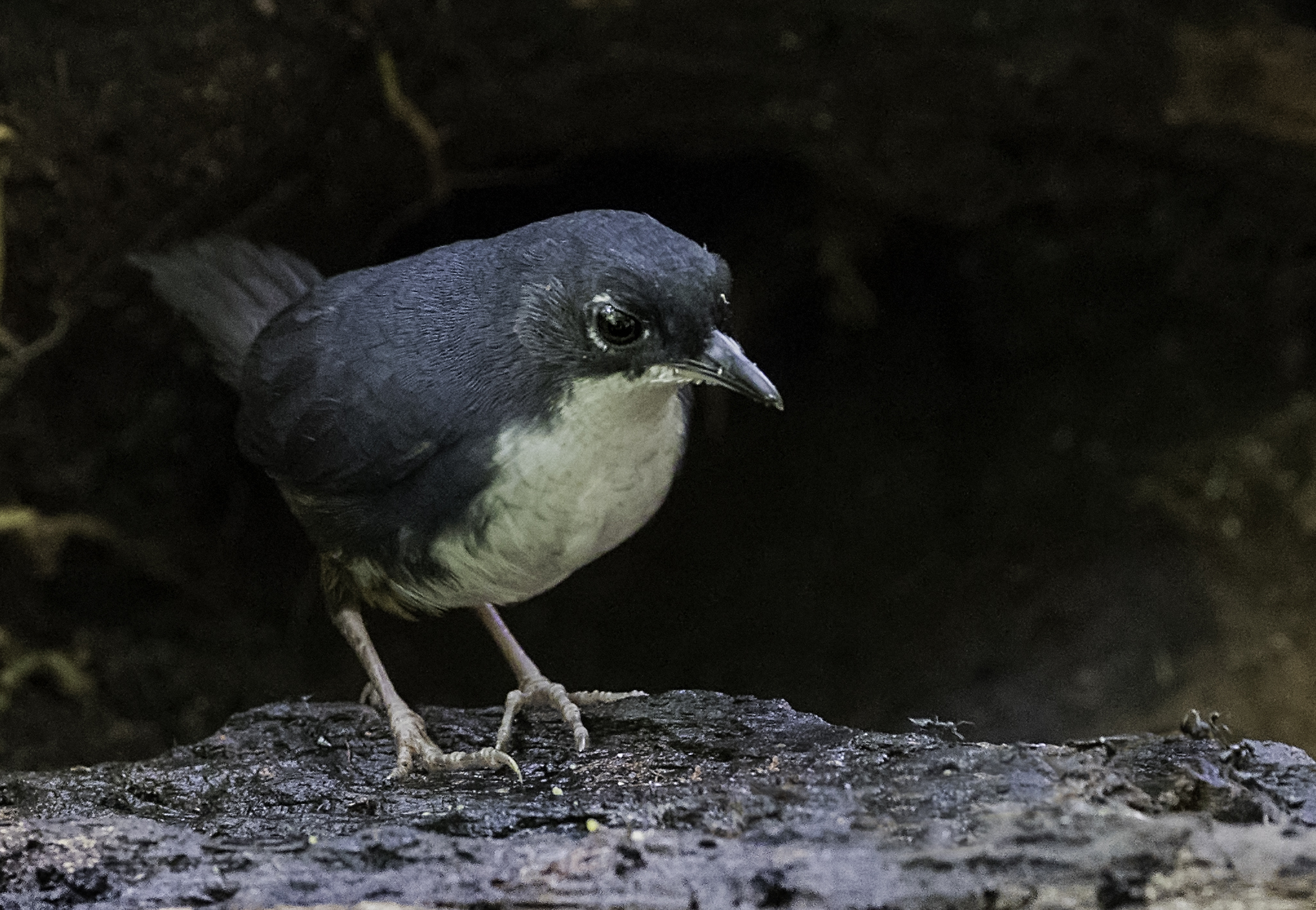
Small tapaculo, about 11 cm; it has a slate-blue back, white underparts and reddish-brown flanks without distinct black bars. The plumage is similar to that of macuquinho-de-peito-branco, but comparative studies also indicate consistent differences in pattern and color, including on the flanks and thighs. Vocalizations and the wing-to-tail proportion also differ between the two species. [1][2]
Habitat
Occurs in humid lowlands of the coastal Atlantic Forest, in dense riparian vegetation along watercourses and in small marshes. It is associated with tangled understory, with lianas, shrubs and fallen wood; it has been found in primary and secondary forests, including altered areas and abandoned rubber plantations. [1][3]
Way of life
It is terrestrial, inconspicuous and difficult to detect; the species' activity and ecology are still poorly known. Sources describe use of low, dense vegetation, where it usually remains concealed. No sufficiently specific information was found in the sources consulted about diet or reproduction; habits of related species are not attributed. [1][3]
Distribution
Endemic to the coastal strip of the state of Bahia, Brazil; published records and surveys include Ilhéus, Una, Igrapiúna, Maraú, Taperoá and Valença. For Bonito/PE: No sufficiently specific information was found in the sources consulted. [1][2]
Conservation
The global IUCN/BirdLife assessment consulted (2022) classifies the species as EN; the official Brazilian national list of Portaria MMA nº 148/2022 also lists it as EN. These are assessments at different scales, and neither constitutes an assessment of the municipal population of Bonito. [1][4]
References
[1]
BirdLife International. Bahia Tapaculo (Eleoscytalopus psychopompus) — Species factsheet. Avaliação global IUCN 2022
de Moraes, L. A. et al. 2018. “Taxonomic review of the rhinocryptid genus Eleoscytalopus (I): Bahia Tapaculo (E. psychopompus) is vocally and morphologically distinct from White-breasted Tapaculo (E. indigoticus).” The Auk 135(4): 1009–1019
Ministério do Meio Ambiente. Portaria MMA nº 148, de 7 de junho de 2022, Anexo II (Lista Nacional Oficial da Fauna Ameaçada; item 523). Diário Oficial da União, 8 jun. 2022