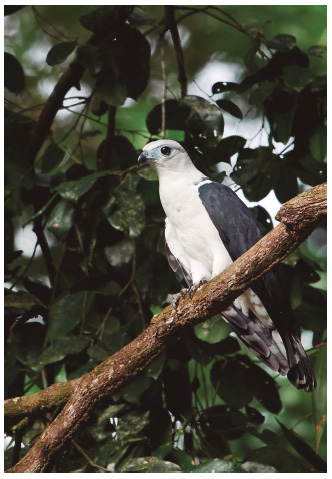
It is a relatively large diurnal bird of prey, with dark gray upperparts and white underparts. The adult is distinguished from the gavião-gato (Leptodon cayanensis) by the white collar encircling the nape, a pale band on the tail, white spots on the mantle, white tips on the secondary remiges, and white underwing coverts. Despite these characters, the literature emphasizes that the species' biology remains poorly known; information about the congener should not be automatically transferred to it. [1][3]
Habitat
Published records occur in open ombrophilous forests and seasonal semideciduous forests. Table 1 of Pereira et al. (2019) includes Engenho Brejão, Bonito, Pernambuco, Brazil, classified as SSF/ETZ (seasonal semideciduous forest/transition). The article describes higher modeled suitability in areas near watercourses; this does not locate the specific point in Bonito, Pernambuco, Brazil next to a watercourse.
Way of life
It is a diurnal bird of prey. Its behavior is little known, although compiled reports mention hunting lizards and consuming birds, insects, and small mammals. The dietary description available on WikiAves is secondary and includes personal observations; therefore it should not be treated as a quantitatively established diet. There is insufficient basis here to detail reproduction or to assert migration. [1][6]
Distribution
Endemic to the Atlantic Forest of Brazil's Northeast, with records concentrated especially in Pernambuco and Alagoas. Table 1 of Pereira et al. (2019) documents Engenho Brejão, municipality of Bonito, Pernambuco, Brazil, with the record referenced to Pereira et al. (2014). The data confirm a published occurrence but do not prove reproduction or current presence.
Conservation
EN — Endangered on the Brazilian Official National List (Portaria MMA nº 1.704/2026, Annex I). Globally, BirdLife/Birds of the World reports EN in the 2018 assessment. The published record in Bonito, Pernambuco, Brazil does not constitute an assessment of the municipal population nor prove current presence.
References
[1]
Distribution, threats and conservation of the White-collared Kite (2019), DOI 10.11606/1807-0205/2019.59.28 — Pereira et al.; Papéis Avulsos de Zoologia / Universidade de São Paulo
Portaria MMA nº 1.704, de 16 de junho de 2026 — Anexo I, Leptodon forbesi, EN — Ministério do Meio Ambiente e Mudança do Clima / Diário Oficial da União