Profile under editorial review. Some profile data, including taxonomic placement, may still be reviewed. Please consult the references listed on this profile.
Description
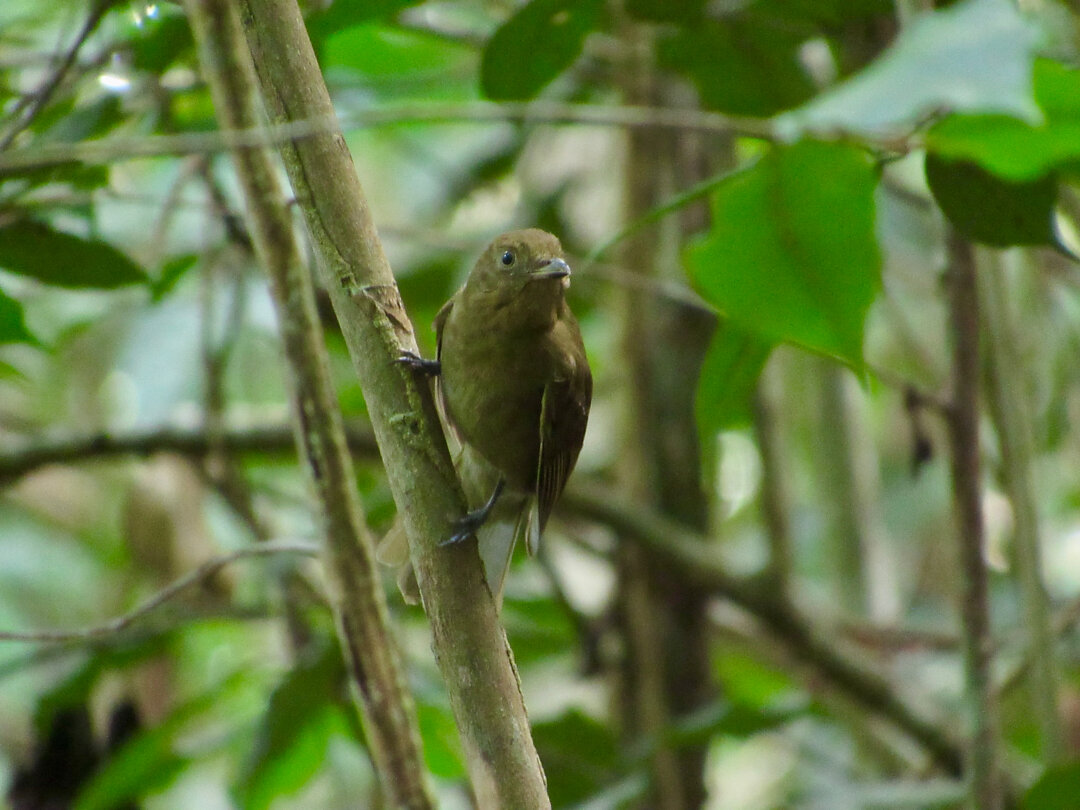
It is a small passerine, about 15.5–16.5 cm and 28–35 g. The plumage is predominantly brown or brownish olive-green, paler on the underparts; the large dark eyes stand out. Forms of the genus have unobtrusive plumage and do not show evident sexual dimorphism. The available description and measurements are of the species in the broad sense, not diagnostic exclusively of intermedia. [1][2]
Habitat
The taxon intermedia is associated with forested areas of the Pernambuco Endemism Center. For Schiffornis, sources describe use of the understory and midstory strata of humid forests; the global assessment also lists lowland and montane tropical moist forest. The general characterization does not prove occupation of a specific habitat in Bonito/PE. [2][3][4]
Way of life
It is inconspicuous and is usually detected more by its whistled vocalization than by visual observation. It feeds on fruits and arthropods/insects and forages in the lower to middle strata of the forest. Sources describe individuals as generally solitary, with occasional participation in mixed flocks; no specific evidence was found that would allow assigning migration or another seasonal pattern to this record. [1][2][4]
Distribution
The form named S. t. intermedia is indicated for the eastern Northeast, in Paraíba, Pernambuco, and Alagoas, and the literature associates it with forested areas of the Pernambuco Endemism Center. [1][2][5]
Conservation
The national assessment cited in the literature consulted treats Schiffornis turdina intermedia as Vulnerable (VU; ICMBio, Livro Vermelho, 2018), while the global BirdLife/IUCN assessment of 2025 lists Schiffornis turdina as Least Concern (LC). The global category refers to the global concept used in that assessment and does not replace the national assessment of the northeastern form. [2][3]
Prado et al. 2022. “Population density estimates for three endangered bird taxa from the Pernambuco Endemism Center, northeastern Brazil”. Biota Neotropica 22(3): e20221361
Pereira et al. 2016. “Distribution and conservation of three important bird groups in the Atlantic Forest of north-east Brazil”. Brazilian Journal of Biology 76(2)
Lobo-Araújo et al. 2025. “Nesting aspects of the brown-winged schiffornis, Schiffornis turdina (Aves, Tityridae), with comments on nestling camouflage”. Zoologia 42: e24083