Profile under editorial review. Some profile data, including taxonomic placement, may still be reviewed. Please consult the references listed on this profile.
Description
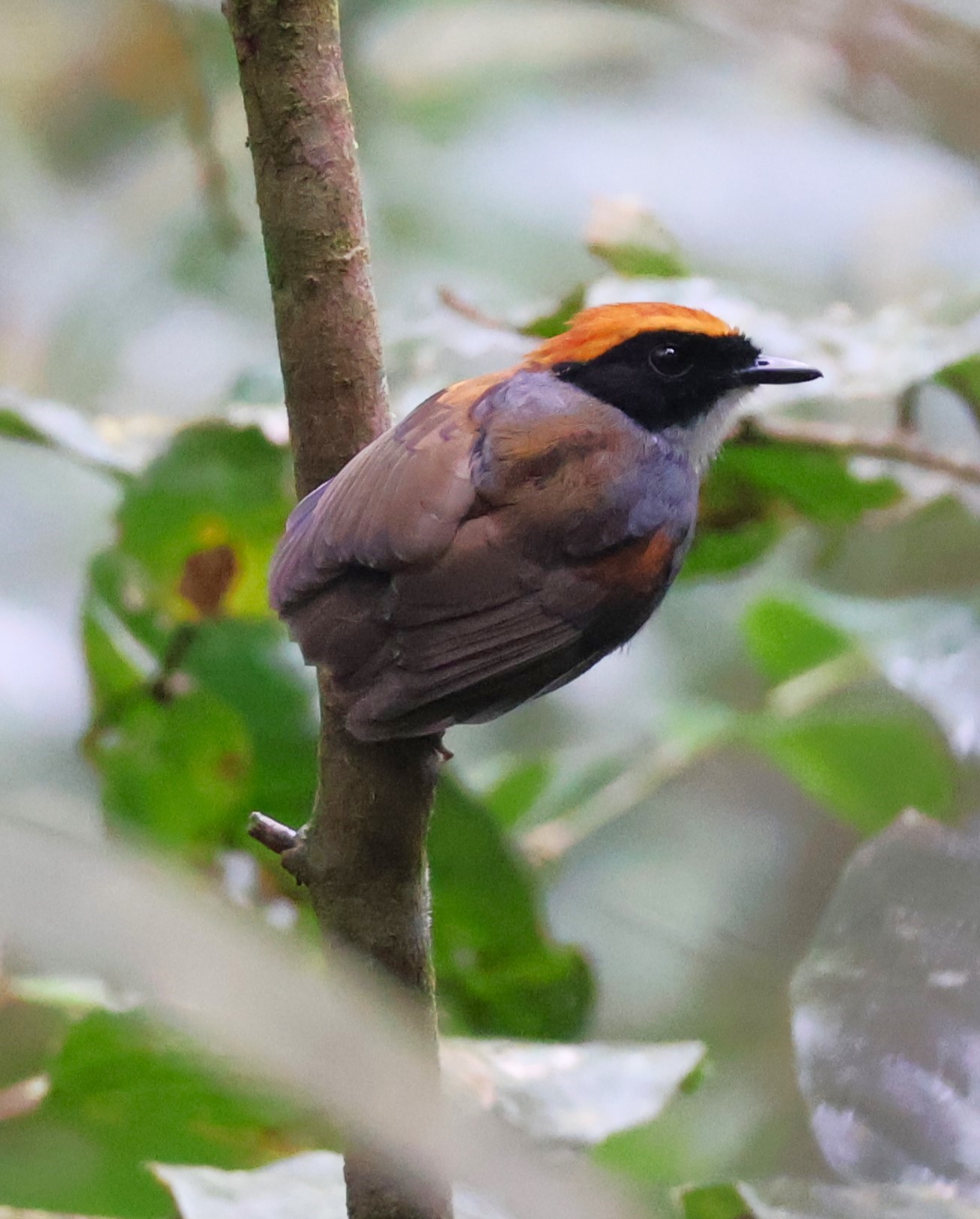
Small understorey bird, about 10.5–12 cm. In the species Conopophaga melanops, the male has a rufous crown, a dark mask and a white throat; the female differs, with a pale stripe above the eyes and orange or ferruginous underparts. The sources consulted treat these characters at the species level and do not present a complete diagnosis that would allow distinguishing them, by themselves, in the subspecies indicated on the record. [1][2]
Habitat
The subspecies is associated with the understorey of forests in the Pernambuco Endemism Center. There are records in open and dense ombrophilous forest, semi-deciduous seasonal forest, and ecotonal areas. In a study in a remnant in Alagoas, it selected sites with denser understorey; the literature also reports occurrence near edges and in regenerating areas. [3][4]
Way of life
It is described as sedentary and forest-dependent. It forages near the ground, alone or in pairs, capturing insects and other arthropods in the leaf litter; it may follow army ants to capture prey. Field research in the Pernambuco Endemism Center recorded individuals visually or audibly, but this does not allow inferring migratory or reproductive patterns for this record. [3][4]
Distribution
The subspecies is reported from Paraíba, Pernambuco and Alagoas. For Bonito/PE, WikiAves lists a first audio record of Conopophaga melanops, published on 7 Jan. 2019; therefore there is municipal-level evidence for the species, but the page does not identify the subspecies nigrifrons. Regional distribution is not used as proof of local subspecific identification. [3][5]
Conservation
At the global level, Birds of the World lists C. melanops as LC (page whose declared update is 2 Dec. 2012); the current dynamic BirdLife/IUCN datasheet was consulted, but the contents of the category and history fields did not load during extraction. At the national/subspecific level, Prado et al. (2022) reports VU for C. m. nigrifrons according to the Livro Vermelho do ICMBio (2018), while Lima et al. (2025), citing MMA (2022), presents the taxon as NT. The sources, years, and taxonomic levels differ; this discrepancy requires verification against the applicable official assessment, without inferring a category for the datasheet or the municipal population. [1][3][6]
References
[1]
Black-cheeked Gnateater — Conopophaga melanops — Birds of the World / Cornell Lab of Ornithology.
Population density estimates and key microhabitat parameters for two endangered tropical forest understory insectivorous passerines from the Pernambuco Endemism Center — Prado et al.; Avian Conservation and Ecology 17(2):22, 2022.