Profile under editorial review. Some profile data, including taxonomic placement, may still be reviewed. Please consult the references listed on this profile.
Description
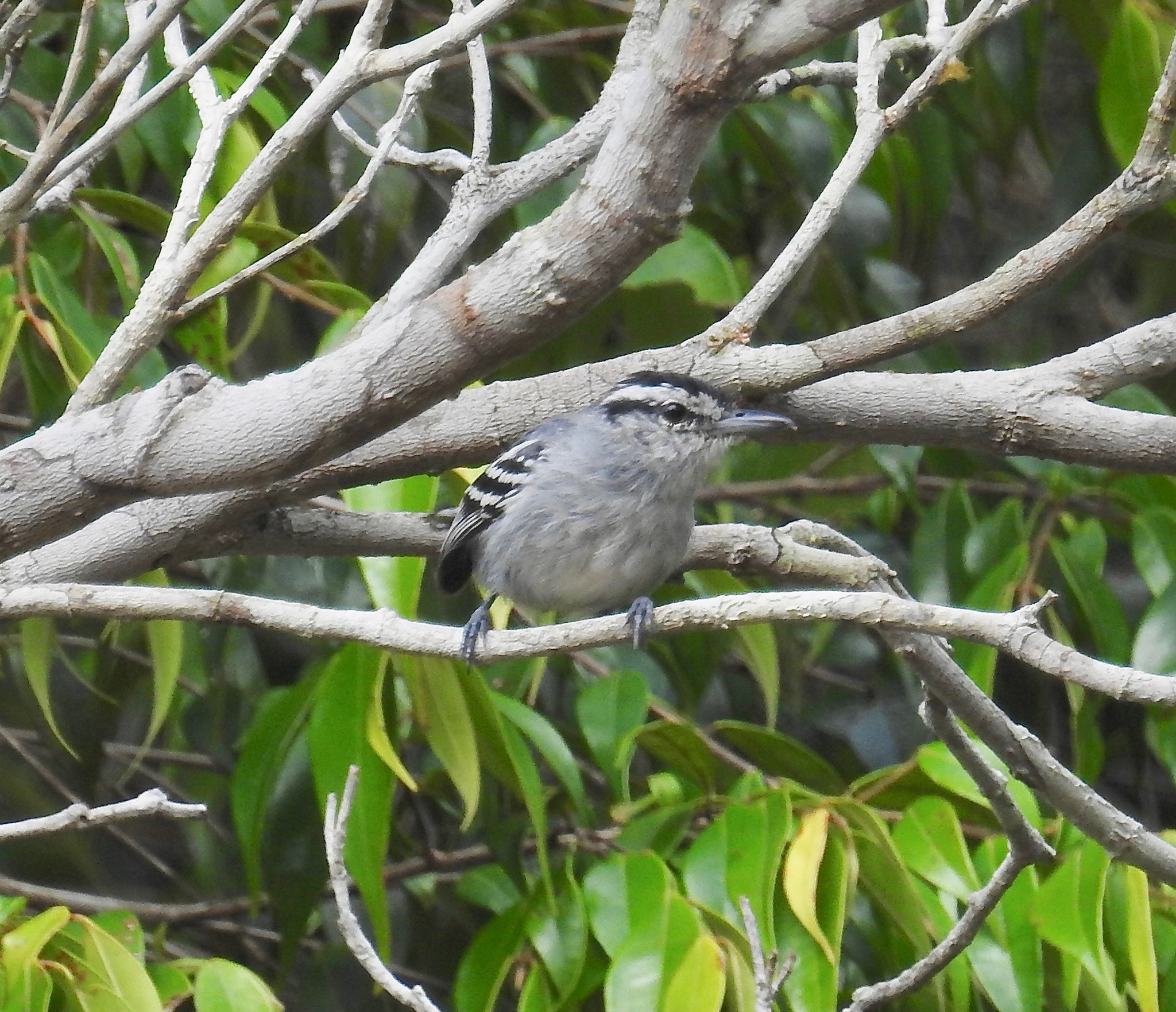
Small passerine of the family Thamnophilidae, measures about 11.5 cm and has a relatively short tail [1]. The taxonomic identity currently recognized as H. pileatus resulted from the revision of a complex that included populations now assigned to H. sellowi and H. atricapillus; the distinction was based on plumage characters in males and females, measurements and, especially, vocalizations [2].
Habitat
It occupies the understory and the canopy of restinga forests, generally on sandy soils [2]. The national assessment describes the species as restricted to conserved restinga and reports absence from small fragments [2]. This description refers to the species' habitat, not to any municipal occurrence.
Way of life
Feeds on insects and probably also on spiders [2]. It uses the understory and the canopy, often participating in mixed flocks in the canopy; it is considered supposedly resident [2]. The assessment itself warns that little is known about its natural history, therefore there is no basis here to detail reproduction or seasonality [2].
Distribution
It is endemic to Brazil and, according to the national assessment and the taxonomic revision, occurs only on the coast of Bahia [2]. Historical identification requires care due to the separation of the complex Herpsilochmus pileatus [2].
Conservation
The global BirdLife/IUCN assessment of 2023 lists Near Threatened (NT), while the national ICMBio assessment published in the 2018 Red Book lists Vulnerable (VU), criterion B1ab(ii,iii) [3][2]. These are assessments at different scales and the years indicated are those of the cited assessments.
References
[1]
WikiAves, “Chorozinho-de-boné (Herpsilochmus pileatus)” (página acessada; sem ano de publicação indicado)
Leal, D. C.; Marques, F. P.; Silva, S. B. L. “Herpsilochmus pileatus (Lichtenstein, 1823)”, em Livro Vermelho da Fauna Brasileira Ameaçada de Extinção, vol. III — Aves. ICMBio, 2018