Profile under editorial review. Some profile data, including taxonomic placement, may still be reviewed. Please consult the references listed on this profile.
Description
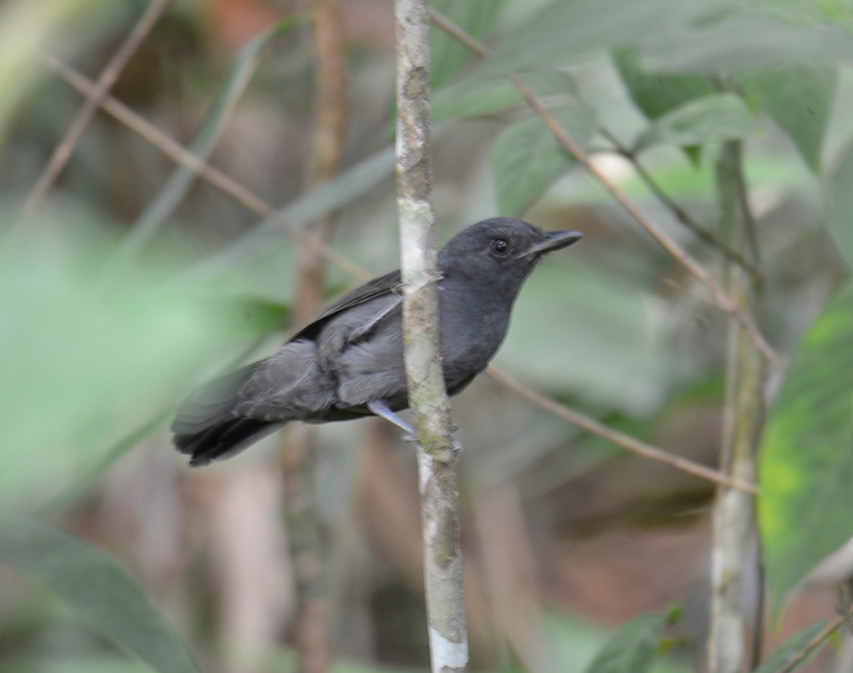
The choca-lisa measures about 16 cm. The male is dark gray, with a black crown and white wing spots absent or very faint in the subspecies distans. The female is reddish-brown, with paler underparts; the iris is reddish in both sexes. These characteristics are described at the species level, and the visibility of the spots varies among subspecies. [1][2]
Habitat
The taxon occupies the understory of mature or secondary forests in late stages of regeneration in the Centro de Endemismo Pernambuco. At the species scale, it is associated with dense, tangled vegetation in lowland forests, especially near natural clearings or watercourses; this broad description should not be taken as proof of habitat in Bonito/PE. [2][4]
Way of life
It is insectivorous and forages in the understory, near the ground, capturing invertebrates. It may follow army-ant swarms and mixed flocks; across much of the species' distribution, solitary individuals or pairs forage independently. The description of pairs and certain behaviors comes from information on the species as a whole, not exclusively from distans. [1][2][4]
Distribution
The subspecies distans is disjunct from the Amazonian distribution of T. aethiops and occurs in the Northeast, with sources indicating Pernambuco and Alagoas. A 2022 study describes 25 forest fragments in Pernambuco, Alagoas and Paraíba; earlier sources delimit the localities to Pernambuco and Alagoas. regional distribution alone is not sufficient to confirm a local record. [2][4][5]
Conservation
The global assessment by BirdLife/IUCN classifies Thamnophilus aethiops as Least Concern (LC) at the species level; the accessible history indicates an assessment in 2016. Separately, the current official Brazilian national list includes T. a. distans as Endangered (EN), Portaria MMA nº 1.704/2026, item 213; a 2022 study records that the national assessment of distans considered by the authors was EN, although a density extrapolation indicated a possible alternative category. The categories are of different scales and taxonomic units and are not directly interchangeable. [6][7]
References
[1]
WikiAves. “Choca-lisa (Thamnophilus aethiops)”. Caracterização, dieta, hábitos e distribuição em nível de espécie/subespécie
Birds of the World / Cornell Lab of Ornithology. “White-shouldered Antshrike (Thamnophilus aethiops)”, introdução. Identificação geral, habitat, comportamento, distribuição disjunta e observação sobre complexidade taxonômica.
Prado, L. C., Dias, T. da C., Lobo-Araújo, L. W., Silveira, L. F. & Francisco, M. R. (2022). “Population density estimates for three endangered bird taxa from the Pernambuco Endemism Center, northeastern Brazil.” Biota Neotropica 22(3).
ICMBio. Livro Vermelho da Fauna Brasileira Ameaçada de Extinção, volume 3 (2018), avaliação de Thamnophilus aethiops distans. Referência oficial de distribuição/localidades e avaliação nacional histórica
BirdLife International. “White-shouldered Antshrike — Thamnophilus aethiops”, Species Factsheet. Avaliação global LC em nível de espécie; histórico da avaliação indica 2016
Pereira et al. (2016). “Distribution and conservation of three important bird groups in the Pernambuco Endemism Center, northeastern Brazil” [página do artigo SciELO]. Menciona áreas montanhosas de Bonito e algumas outras aves dessas áreas; — não documenta T. aethiops distans nelas
WikiAves. Painel municipal de Bonito/PE, registros recentes selecionados por colaboradores; usado apenas como verificação limitada, não como lista completa nem evidência de ausência