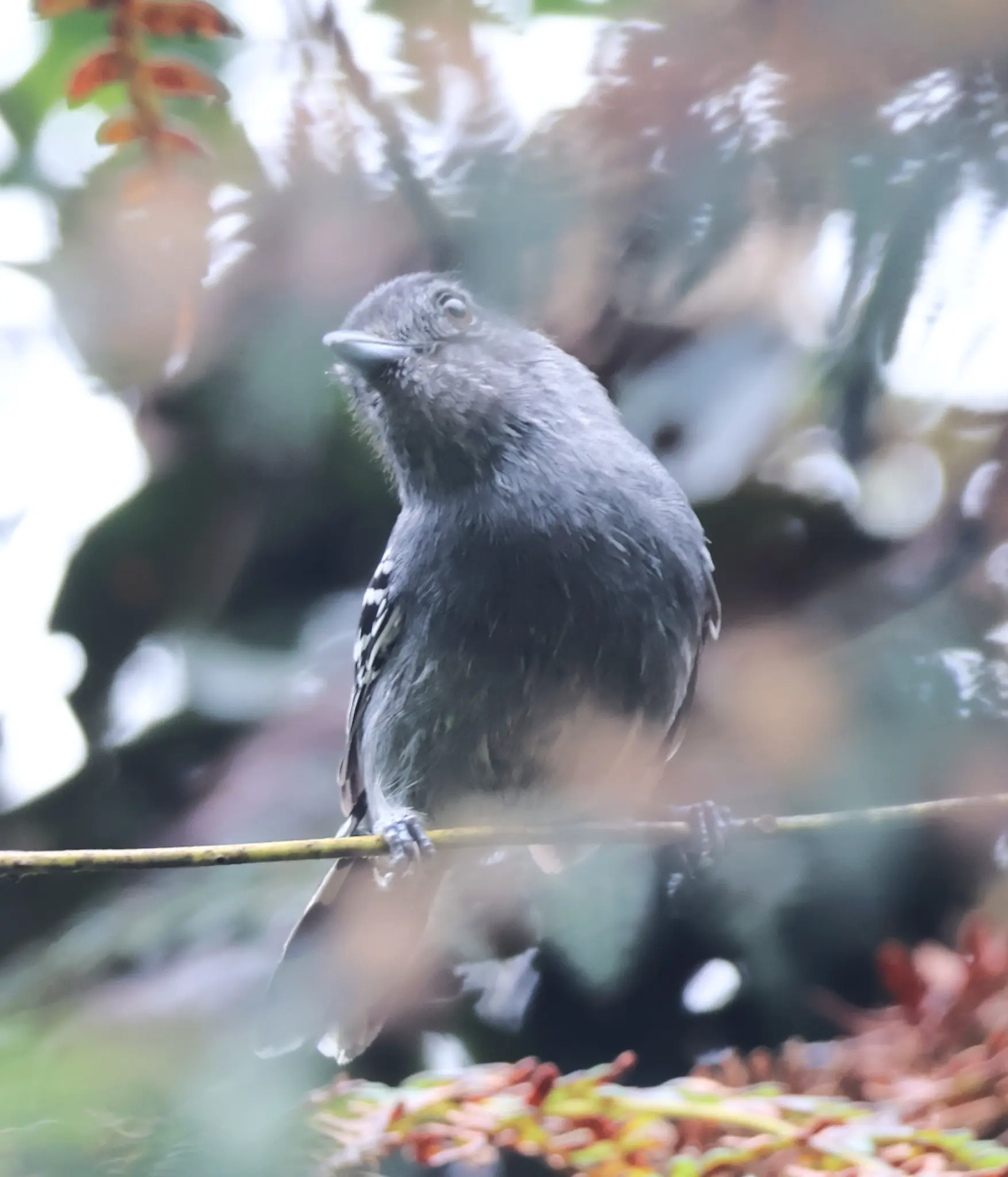
Profile under editorial review. Some profile data, including taxonomic placement, may still be reviewed. Please consult the references listed on this profile.
Description
The species has plumage that varies among populations and shows sexual dimorphism: general descriptions characterize males as grayish, with a dark crown, and females as brown; both have pale spots on the wings. It measures about 14–16 cm. Because these characters are presented for T. caerulescens in the broad sense, they should not be taken as a confirmed diagnosis of the form pernambucensis. [1][2]
Habitat
For T. caerulescens in the broad sense, sources describe occurrence in the understory, usually between 1 and 8 m, on edges of evergreen forests and in more open situations. They also cite secondary forests, gallery forests, and edges of dense forest. These data are general for the species and do not specifically characterize the nominal form of the profile nor a point in Bonito. [1][2]
Way of life
It is mainly insectivorous: it searches for prey among leaves and branches, moving by small hops and inspecting the vegetation; upon locating prey, it captures it in the foliage. Fruits are also mentioned as part of the diet. The foraging description comes from reports for T. caerulescens in the broad sense and has not been specifically verified for pernambucensis. [1][2]
Distribution
The regional distribution of the complex includes the Brazilian Northeast; general sources place the population traditionally called cearensis in Ceará, Pernambuco and Alagoas. There is a divergence in classification: recent references discuss cearensis as a species, while the administrative record uses pernambucensis as a subspecies of T. caerulescens. For municipal occurrence in Bonito/PE: no sufficiently specific information was found in the sources consulted. The accessed municipal eBird list did not display the species list. [1][3][4][6]
Conservation
At the global scale, the Birds of the World record lists T. caerulescens as LC (Least Concern); the consulted page does not show the year of assessment. The BirdLife/IUCN page consulted also did not load the details of the category/year. At the national scale, WikiAves assigns the northeastern form called cearensis the category Vulnerable under Portaria MMA nº 444/2014; this is a secondary and outdated reference, not a verification of the current official national list for the registered name pernambucensis. Scales and taxonomic concepts are not directly interchangeable. [1][2][5]