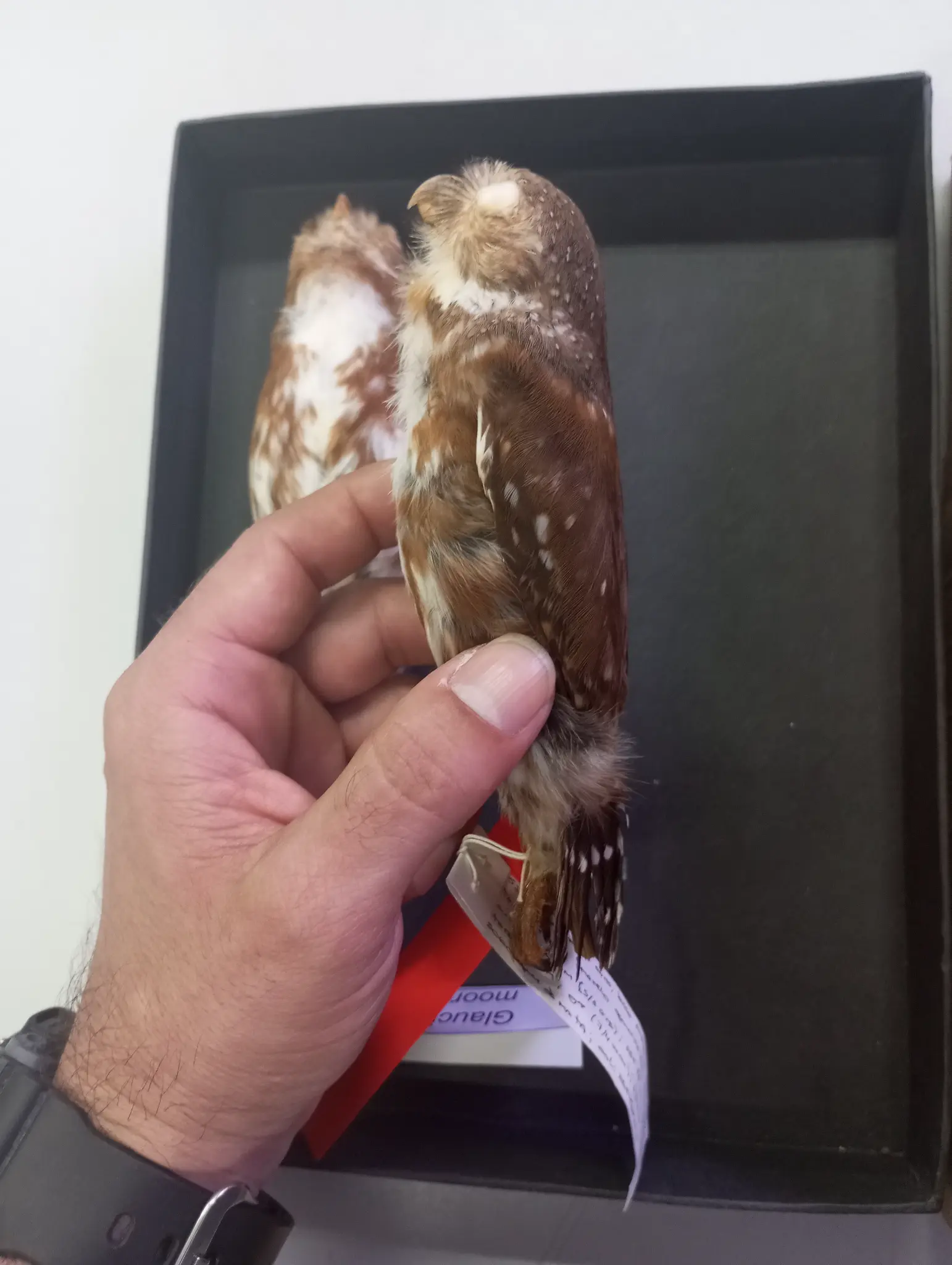
Documentary image of a preserved Pernambuco Pygmy-owl (Glaucidium mooreorum) specimen held in hand, with another specimen in the background; this is not a photograph of a live bird in the field. · Olavo Uziel Campelo
Notes and context
Profile under editorial review. Some profile data, including taxonomic placement, may still be reviewed. Please consult the references listed on this profile.
Description
A small owl described in 2002 from two specimens collected in the Reserva Biológica de Saltinho. It has a brown back, head and face speckled with white, and pale underparts with brown markings; the iris, bill and legs were described in shades of yellow. It is distinguished from nearby species also by measurements and vocalization; the known song is a short phrase of five to seven notes. The original identification was based on specimens and comparison of plumage, morphometrics and voice. [2][5]
Habitat
Known from remnants of low forest in Pernambuco. The original description mentions tall secondary forests in low-altitude localities, including the type locality of Saltinho, in Rio Formoso. None of these sources document occurrence in Bonito, Pernambuco, Brazil.
Way of life
The life history remains essentially unknown. There is a recording of the vocalization and the species description records a short song of five to seven notes; the sources consulted do not establish diet, daily behavior or reproduction. Therefore, no habits known only from other Glaucidium are attributed to the species. [2][5]
Distribution
Species endemic to Pernambuco in the consulted sources. The published localities include Saltinho, in Rio Formoso, and a forest fragment near Sirinhaém.
Conservation
EX — Extinct in Brazil in Annex II of Portaria MMA nº 148/2022. The global assessment reported by BirdLife in 2020 is CR (Possibly Extinct), a distinct category that does not confirm global extinction.
References
[1]
Portaria MMA nº 148, de 7 de junho de 2022 — Anexo II, Glaucidium mooreorum, EX — Ministério do Meio Ambiente / ICMBio