Profile under editorial review. Some profile data, including taxonomic placement, may still be reviewed. Please consult the references listed on this profile.
Description
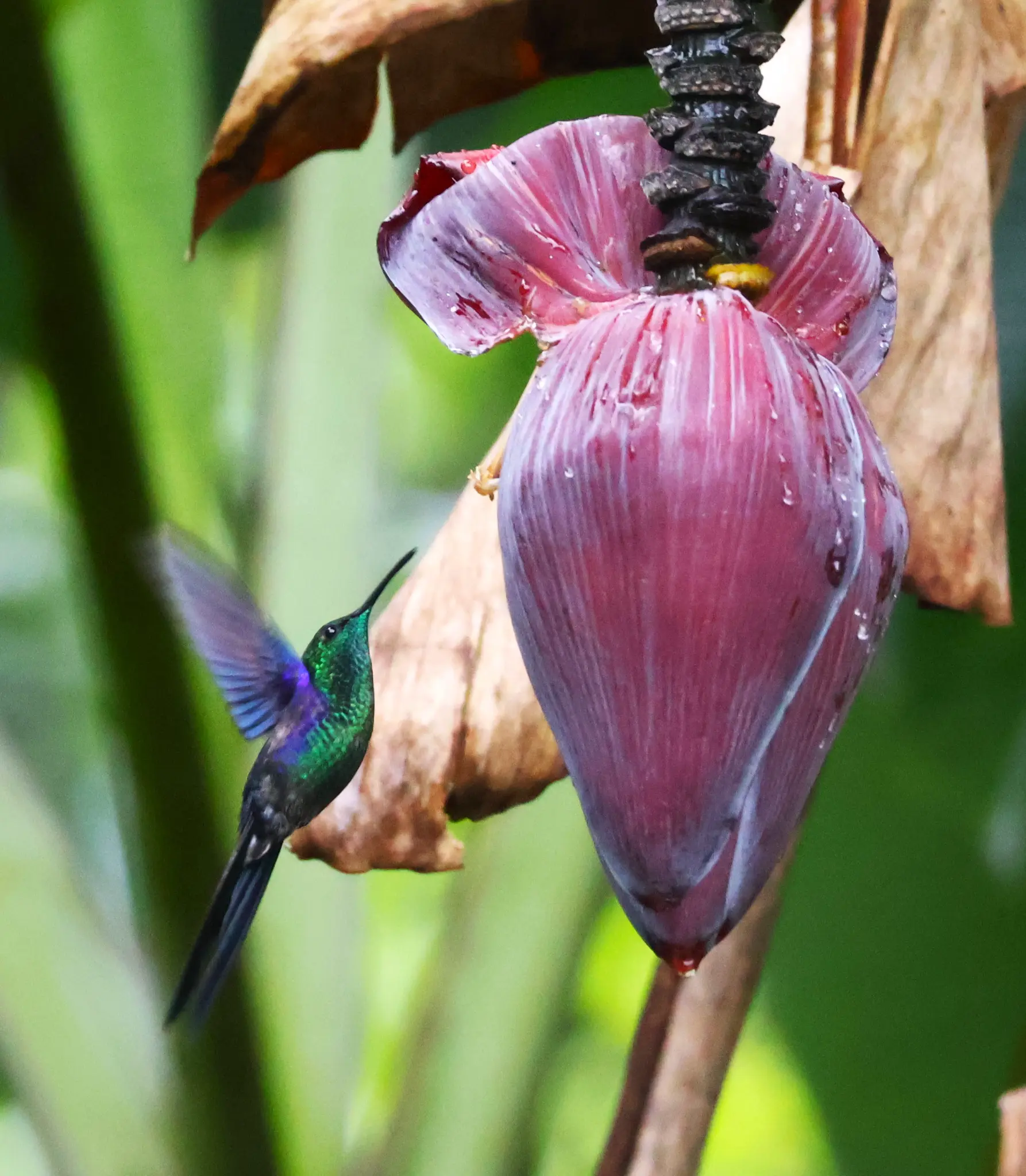
Hummingbird of the family Trochilidae, endemic to northeastern Brazil and reliably known from Pernambuco and Alagoas. The literature reports visits to the flowers of various plants to obtain nectar and occasional consumption of invertebrates; males defend territories against other hummingbirds and individuals of the same species. The species has been documented in fragments of Mata Atlântica; historical records and records from isolated localities require critical evaluation [1][3].
Habitat
The reviewed confirmed records are located in Mata Atlântica areas, in lowland coastal forest and slope forests, including high-altitude swamps. Although earlier sources mention cerrado, plantations and parks, the recent review did not find evidence of occurrence in Cerrado sensu stricto and questions robust evidence in planted environments or parks [1][2].
Way of life
Forages in the understory and mid-stratum, usually at vegetation edges, consuming nectar from various plants and, occasionally, invertebrates. Males defend territories against conspecifics and other hummingbirds. Reproduction has been documented between October and March, but the literature notes that knowledge about ecology and reproduction remains incomplete [1][3].
Distribution
Endemic to Brazil, it is reliably known from Pernambuco and Alagoas. A review of records compiled 29 confirmed localities in these states (15 in Pernambuco and 14 in Alagoas) and discarded several old or uncertain occurrences outside this core. The publication also lists Brejão, in the municipality of Bonito/PE, with specimens of originally uncertain identification and multiple observer records on eBird/WikiAves; this provides published evidence for the locality, but not current presence [1][5].
Conservation
The national assessment in the Livro Vermelho do ICMBio (2018) classified the species as Endangered (EN) and recorded occurrence in Pernambuco, Alagoas and Sergipe; in that volume, the global assessment then cited was Near Threatened (NT) [4]. The current global assessment presented by BirdLife/IUCN is EN (2023) [2]. Berryman et al. (2023) reviewed the records and argued that the confirmed distribution and habitat data could justify Vulnerable (VU) instead of EN; this is a scientific analysis that questions the global assessment, not a formal substitute category [1].
References
[1]
Berryman, A. J. et al. (2023). “The distribution, ecology and conservation status of the long-tailed woodnymph Thalurania watertonii.” Ornithology Research