Profile under editorial review. Some profile data, including taxonomic placement, may still be reviewed. Please consult the references listed on this profile.
Description
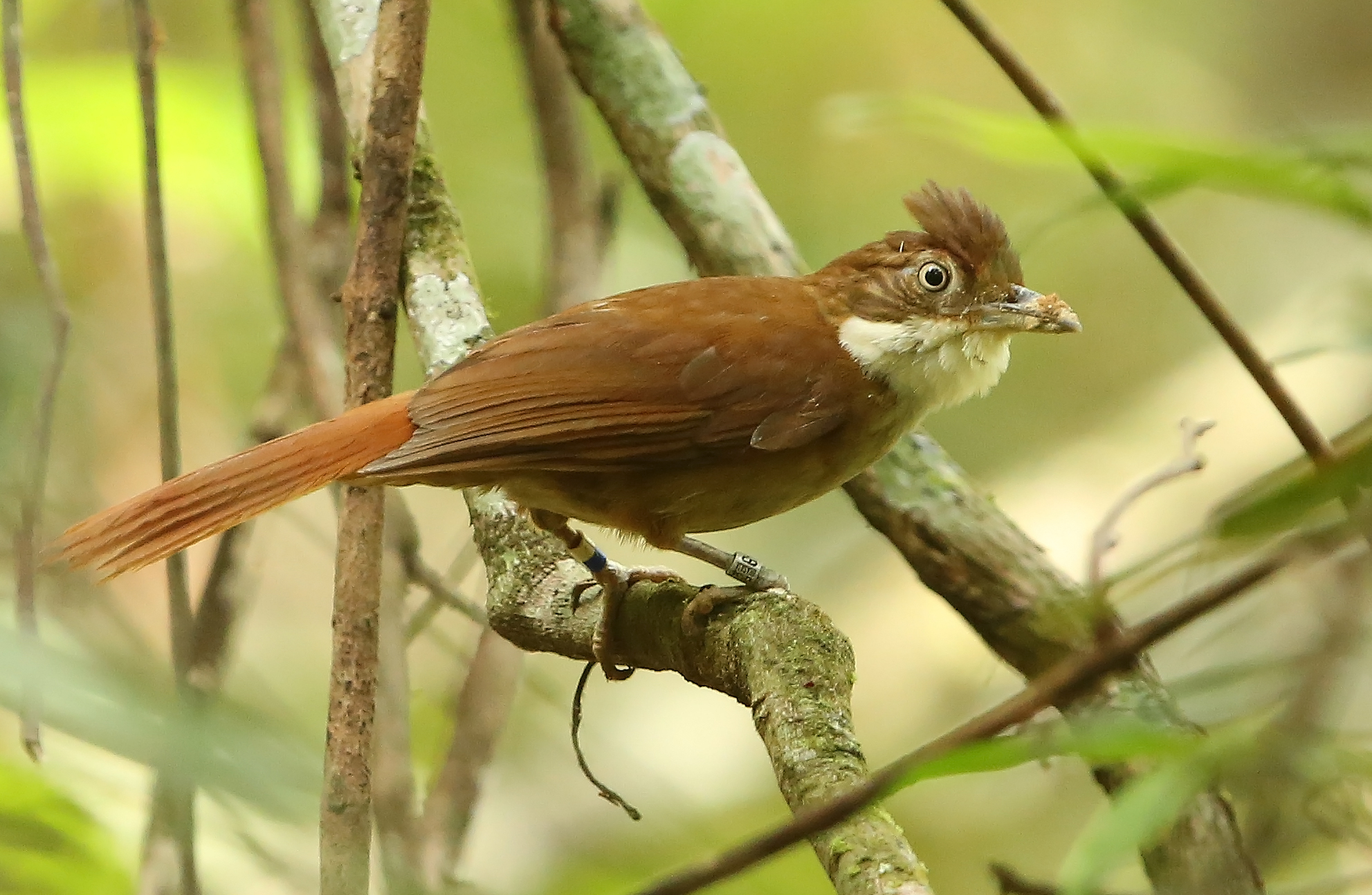
Passerine of the family Furnariidae, about 19–20 cm in length. It has rufous plumage, pale eyes and a white throat. Its appearance is very similar to that of the barranqueiro-pardo (Automolus leucophthalmus), and the external differences are subtle; the distinction between the taxa was supported mainly by vocal differences, as well as by biometric and plumage analyses. [1][2][3]
Habitat
Associated with the humid Atlantic Forest, in forest fragments of the Pernambuco Center of Endemism and neighboring areas. The national assessment describes a preference for more structurally complex and humid forest, with streams in the forest interior; a 2026 study also links occupancy to distance from edges and watercourses. Recent sources report a preference for tall trees, closed canopy and open understory. [4][5]
Way of life
It is dependent on forest microhabitat; the national assessment reports an association with small streams and an absence of movement between fragments. A recent study relates its occurrence to forest structure and distance from edges and watercourses. The sources accessible in this research do not support a specific description of diet or foraging routine, which should not be completed by extrapolation from congeners. [4][5]
Distribution
Endemic to Brazil, associated with the Pernambuco Center of Endemism and recorded in sources for Pernambuco, Paraíba, Alagoas and Sergipe; the national assessment also includes Bahia in the occurrence summary. WikiAves describes a broader range, from southeastern Rio Grande do Norte to northeastern Bahia, a difference that should be treated as a boundary between distribution syntheses, not as a taxonomic correction. [1][2][4]
Conservation
Differentiate scopes: the global source Birds of the World identifies the species as EN (Endangered); the BirdLife/IUCN page consulted loaded the assessment fields without their values, therefore the year of the global assessment could not be confirmed directly. At the national level, the ICMBio/SALVE record states EN, with the category date June 14, 2019 and publication in 2023; Portaria MMA No. 1.704/2026 also includes Automolus lammi as EN in Annex I, item 143. These assessments are global and national, respectively, and none is a municipal assessment for Bonito. Do not overwrite or reinterpret the conservation text already registered. [2][4][6]
Lima, D. M. et al. “Habitat selection, occupancy and density of threatened birds in a tropical forest fragment of the Northern Atlantic Forest, Brazil”. Ornithological Research 34, 53 (2026)
Ministério do Meio Ambiente e Mudança do Clima. Portaria MMA nº 1.704, de 16 de junho de 2026, Anexo I, item 143 (Automolus lammi, EN). Diário Oficial da União, publicado em 17/06/2026