Profile under editorial review. Some profile data, including taxonomic placement, may still be reviewed. Please consult the references listed on this profile.
Description
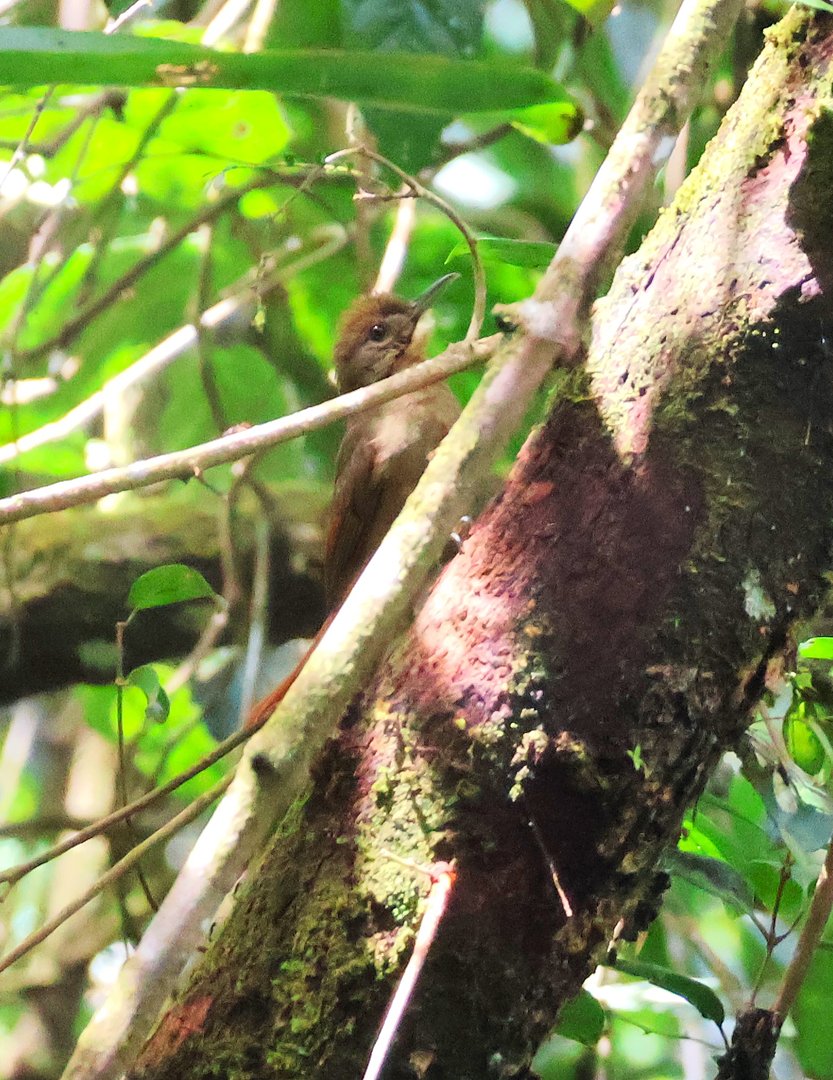
The profile refers to the arapaçu-pardo-do-nordeste, a taxon treated in some lists as Dendrocincla turdina taunayi and in others under combinations linked to D. fuliginosa; this variation is recorded here without proposing taxonomic correction. [1][5] It is a medium-sized woodcreeper; the taunayi form is described as having a more streaked crown than the nominal form, lacking a supercilium and without spots on the whitish throat. [1] The species is little studied compared with more widespread congeners. [1]
Habitat
It is associated with humid, evergreen forests, especially in lowlands and foothills; the reference source reports occurrence up to 2,000 m, generally below 1,300 m. [3] There are also less frequent records in gallery and deciduous forests, and occasional records in mangroves. [3] The WikiAves profile describes the northeastern form in lowland humid forest, in the interior and at the edges, using the mid-stratum and understory. [2]
Way of life
It feeds mainly on insects and other arthropods, as well as other invertebrates; the species summary reports that it regularly follows army-ant swarms, capturing prey flushed out. [1] Studies of the genus Dendrocincla also describe ant-following species that consume arthropods driven out by ants or other animals. [6] The habits of the taunayi form are poorly documented, therefore no details on breeding, migration, or activity are added here. [1]
Distribution
The taunayi form is indicated as restricted to northeastern Brazil, in eastern Pernambuco and Alagoas; WikiAves also presents it as endemic to Brazil and to the Centro de Endemismo Pernambuco. state or regional distribution was not used as proof of local occurrence. [2]
Conservation
The consulted global BirdLife/IUCN assessment classifies Dendrocincla turdina as LC (Least Concern) in 2024, under a taxonomic concept that does not correspond directly to the administrator entry D. taunayi. [3] Separately, the Lista Nacional Oficial brasileira published by Portaria MMA nº 1.704/2026 lists Dendrocincla taunayi as EN (Endangered). [4] The two categories have distinct geographic scopes and taxonomic concepts; record this difference for review, without modifying the status already registered.
References
[1]
Marantz et al. (2020). Plain-winged Woodcreeper (Dendrocincla turdina), version 1.0. Birds of the World / Cornell Lab of Ornithology