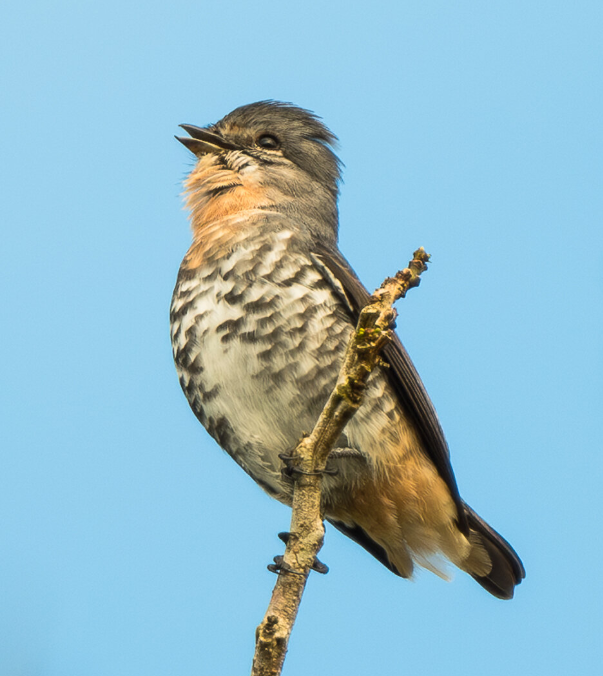
Profile under editorial review. Some profile data, including taxonomic placement, may still be reviewed. Please consult the references listed on this profile.
Description
Small bird with predominantly gray plumage, a cinnamon or brownish-pink throat, long wings and a short tail. The consulted account estimates about 9.5 cm in length. In the male there is a tuft of violet feathers on the sides of the breast, usually concealed by the wings; the northeastern form is described as having a white band on the lower back. [1]
Habitat
The species is mainly associated with the canopy of coastal Atlantic forests at low to mid elevations in eastern Brazil. For the anambezinho, the consulted field source also mentions forested slopes, edges and clearings; these details are general descriptions and do not demonstrate habitat use in Bonito/PE. [1][2]
Way of life
It remains mainly in the upper canopy and may perch motionless on exposed thin branches, which makes it difficult to detect. The consulted source reports consumption of small fruits and also capture of insects and larvae in the vegetation or during short flights. These details are general for the species and were not specifically verified for the subspecies in Bonito. [1]
Distribution
The subspecies leucopygia is indicated for the coastal belt of the Northeast, from Paraíba to Bahia, including Pernambuco and Alagoas. This subspecific delineation should not be confused with the broader distribution attributed to the species, which includes the Southeast. [3][4][6]
Conservation
The source Birds of the World lists the species as Endangered in the IUCN global assessment, but the consulted page does not specify the year of the assessment. Separately, Portaria MMA nº 1.704, de 16 de junho de 2026, lists Iodopleura pipra leucopygia as EN in the national assessment. The global and national scales are distinct; no conservation assessment specific to the municipality of Bonito was found. [2][5]
da Costa Dias, T. et al. (2024). “Endemic and threatened birds as surrogates for identifying conservation priority areas in the Pernambuco Endemism Center”. Scientific Reports